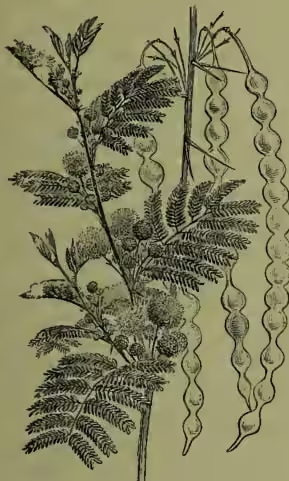
Acacia, an important genus of leguminous trees or shrubs, of the sub-order Mimoseæ. The species are for the most part natives of tropical Africa (140 species) or Australia (280 species), are frequently thorny, and exhibit extraordinary differences in general appearance, owing to the remarkable modifications of the vegetative organs. The normal type of leaf is bipinnate (fig. 1); but is often modified, especially among the species which have had to become adapted to the intense heat and drought of Australia, where they greatly abound, forming 'acacia-scrub.' The leaf-blade entirely ceases to be developed, and the leaf-stalk becomes vertically flattened into a 'phyllode,' which thus resembles a simple leaf, and performs vegetative functions; but, like the leaves of many species of Eucalyptus, presents only its edge to direct sunshine; and by its thick and strong epidermis is further adapted to resist transpiration. The line of modification is beautifully indicated by such a species as Acaea heterophylla (fig. 2), in which, along with the
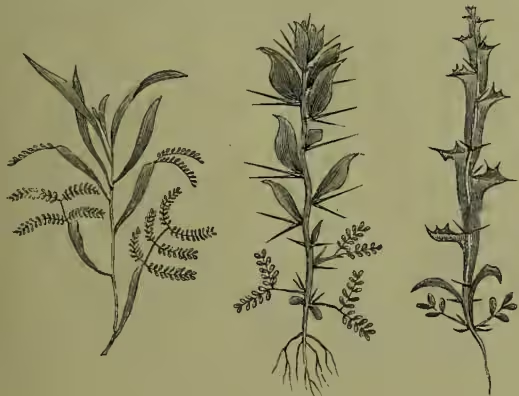
Fig. 3.
Fig. 4.
phyllodia, many of the normal bipinnate leaves survive; as also by seedlings (fig. 3), which invariably develop one or two bipinnate leaves after the cotyledons, and usually also show transitional forms to phyllodia, even in species so extremely modified as Acacia alata, where even the phyllodial type becomes disguised by the downward continuation of the phyllode into an expanded wing running down the stem, somewhat like the decurrent leaves of a thistle (fig. 4). Many species are also cultivated in our greenhouses for the sake of their flowers, which are united into golden stamen-tufts of great beauty, and are often fragrant. The leaves often exhibit Sleep-movements (q.v.) analogous to those which are developed into sensitiveness in some of the allied Mimosas (see SENSITIVE PLANT), and in some species close whenever the sun is clouded. The genus is also of great and varied economic importance, not merely as frequently yielding timber or edible seeds in the regions where they flourish, but as possessing the astringent and gum-yielding properties common in the sub-order in the highest degree. The drug known as Catechu (q.v.) is prepared from Acacia catechu; while of still greater importance are the products yielded by the degeneration of the cell-walls of the inner bark (bast-parenchyma and sieve-tubes). These substances are known in commerce as Gum-Arabic, Gum-Senegal, &c., and are obtained from Acacia arabica, Acacia senegal, and other species (see GUM). Some species of Robinia, such as the North American locust-tree (R. pseud-acacia), R. hispida, Rose acacia, &c.—are often erroneously called acacia in Europe and the United States, sometimes also thorn-acacia (a false acacia), but belong to a distinct sub-order of Leguminosæ, the Papilionaceæ, having violet, pea-like flowers. Flores Acacie is an old medical name for sloe-flowers.