Acorn-shells (Balanus), a genus of Cirripedes (q.v.), in the class Crustacea. The classical title refers to that remote resemblance to acorns which their popular name also records. They occur in great abundance incrusting the rocks between high and low water mark, and are exceedingly familiar objects. At first sight, and in their adult form, all cirripeds are so unlike crustaceans, that even Cuvier regarded them as molluscs. In 1829, however, their true nature was detected by Vaughan Thompson, who observed the young forms to be free-swimming, and to exhibit characters which stamp them at once as crustaceans.
Structure.—The common sessile acorn-shell may be briefly described in Huxley's words as 'a crustacean fixed by its head, and kicking its food into its mouth with its legs.' The body is enveloped in a fold of skin, or mantle, which forms round about the animal a conical protective shell of six pieces, and a fourfold movable lid. When the animal is active (only, of course, under water), six pairs of curl-like double legs may be seen alternately protruded and retracted through the valvular opening of the shell. These are borne on the thorax of the animal, and serve to brush the floating food down to the mouth, where it is seized and masticated by the three pairs of jaws. The abdominal portion of the animal is degenerate, and the characteristic crustacean jointing is at best indistinct. Since the animal really stands on its head, the single pair of antennæ are found on the middle of the base or lower surface, and are extremely reduced. The attachment is effected by the hardened secretion of complex cement-glands, which probably represent modified excreting organs. The special sense organs degenerate, but the nervous system is well developed, and the surface of the legs seems to have a general tasting sensitiveness. The alimentary canal is in no way peculiar; and though no heart has been demonstrated, the blood has a definite course. Respiration must be largely effected by the ceaselessly waving legs, but there are also folded plates on the inside of the mantle which may represent special breathing organs. The acorn-shells are hermaphrodite, and the eggs are attached to the folded plates just mentioned. When the young larvæ free themselves from their egg-cases the shell is opened, and the legs cease to kick till they effect their escape.
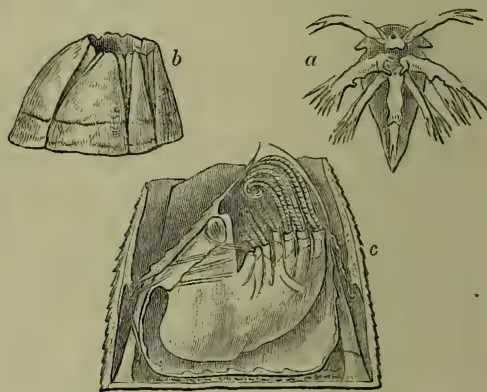
Life-history.—The contrast between the sessile adults and the free-swimming young is very striking. The first larval stage is a Nauplius (q.v.) like that of other lower crustaceans. It has the usual three pairs of legs, an unpaired eye, and a delicate shield on its back. It moults several times, grows bigger, and develops a firmer shield, a longer spined tail, and stronger limbs. The second short chapter in its history is known as the Cypris stage, in which the larva acquires two side eyes, six pairs of swimming legs, a bivalve shell, and other organs. At the end of this stage, during which no food is eaten, the larva becomes fixed by its feelers and the glue of the cement-gland. A new regime begins; some organs such as the side eyes, the antennæ, the bivalve shell, the tail, and the swimming legs, are lost; while new structures appear, such as the curled waving legs, and the incipient external shell. During these changes there is quiescence and fasting, and the stage was described by Darwin as the 'pupa.' The skin of the pupa moults off, certain changes of position take place, and the permanent structure and activities of the adult are gradually assumed. The external firm shell of the rapidly growing adult cannot, of course, be moulted, but at frequent periods the whole lining of the shell and the skin of the legs is shed (see SKIN-CASTING). These cast coats are exceedingly common, especially during the spring months. Darwin quotes an observation of Mr C. W. Peach, who notes their extraordinary abundance, and says, 'he could easily have filled several quart measures with them.'
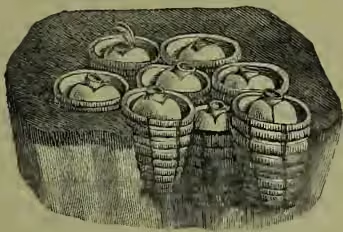
(From Bronn's Thier-Reich.)
The acorn-shells feed on small marine animals. They are attached not only to rocks, but to floating objects and to other animals. Numerous species are known, of which B. improvisus inhabits brackish water. The sessile Balanidae differ from the stalked Barnacles (q.v.) or Lepadidae only in detail; in both families the waving legs are borne by the thorax, and they were therefore classed by Darwin, in his famous memoir of the Cirripedia, in the sub-order Thoracica. Some of the larger species of balanus were esteemed by the Romans, and are still eaten by Chinese and others. B. psittacus sometimes measures 4 inches in diameter, and B. tintinnabulum is also large. See Darwin's Monograph of Cirripedia (2 vols. 1851-54); Huxley's Invertebrata.