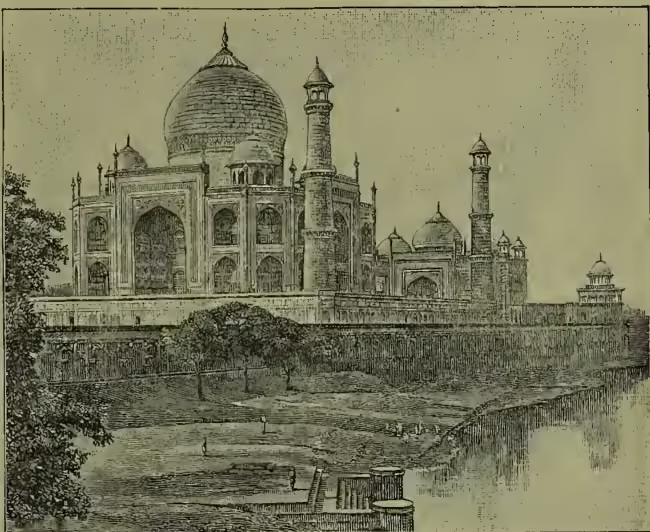
From a photograph by Frith.
Agra, a city in the North-western Provinces of India, situated on the right bank of the Jumna, 139 miles SE. of Delhi by rail, and 841 NW. of Calcutta. The ancient walls of the city embraced an area of about 11 square miles, of which about one-half is now occupied. The houses are for the most part built of red sand-stone, and, on the whole, Agra is the handsomest city in Upper India. Some of the public buildings, monuments of the house of Timur, are on a scale of striking magnificence. Among these are the fortress built by Akbar, within the walls of which are the palace and audience-hall of Shah Jehan, the Moti Masjid or Pearl Mosque, so called for its surpassing architectural beauty, and the Jama Masjid or Great Mosque. Still more celebrated is the Taj Mahal, situated without the city, about a mile to the east of the fort. This extraordinary and beautiful mausoleum was built by the Emperor Shah Jehan for himself and his favourite wife, who died in 1629; and 20,000 men were employed incessantly on it for twenty-two years. The complexity and grace of the general design, and the elaborate perfection of the workmanship, are alike remarkable. The main features of the building are the mausoleum in the centre, on a raised platform, surmounted by a beautiful dome, with smaller domes at each corner, and four graceful minarets (133 feet high). The principal parts of the building are constructed of white marble; and the mosaic work of the interior is singularly rich and beautiful. Of British edifices in and near the city, the principal are the Government House, the Government College, three missionary colleges, the English church, and the barracks. The climate at Agra, during the hot and rainy seasons (April to September), is very injurious to Europeans; but the average health of the city is equal to that of any other station in the North-western Provinces. Agra is fortified and has a garrison; there is a military station in the neighbourhood of the city. The principal articles of trade are cotton, tobacco, salt, grain, and sugar. There are manufactures of shoes, pipe stems, and gold lace, and of inlaid mosaic work, for which Agra is famous. It is a very important railway centre, and has many claims to be regarded as the commercial capital of the North-west. Pop. (1891) 168,622, of whom 45,000 are Mohammedans.
This city is held in great veneration by the Hindus, as the scene of the incarnation of Vishnu under the name of Parasu Rama. It first rose to importance in the beginning of the 16th century, and till 1658 was the capital of the Mogul sovereigns. In that year Aurungzebe removed to Delhi; henceforth Agra declined. It was taken in 1784 by Sindhia, and surrendered in 1803 to Lord Lake. From 1835 till 1862, Agra was the seat of government for the North-west Provinces. During the mutiny the Europeans had, in June 1857, to abandon the city and retire to the Fort or Residency. Heroic sallies were occasionally made; and Agra was relieved early in October by the rapid and brilliant march of Colonel Greathed.—The 'district' of Agra is for the most part very level, and is deficient in water, though the soil is rich. Sinkandra is a suburb. The population in 1891 was 1,003,796, of whom about 100,000 were Mohammedans, Europeans, &c., the rest Hindus.—The 'division' of Agra embraces six districts, with an area of 10,139 sq. m., and pop. of 4,767,759.