Air-bladder, or SWIMMING-BLADDER, a sac pushed out from the alimentary canal of fishes, and discharging a respiratory or a hydrostatic function. Its origin and modifications resemble those of lungs, and in the highest fishes, Dipnoi (q.v.), the air-bladder is really a lung. Lungs, however, arise ventrally, while the air-bladder is usually dorsal, and, except in the transitional forms, not in such special connection with the circulatory system. This organ is first hinted at in Elasmobranchs, and occurs in all Ganoid and in most Teleostean fishes.
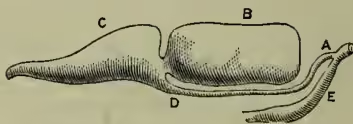
Consisting of two parts, B and C, joined by a narrow neck;
A D, a canal communicating with oesophagus, E.
The original connection with the alimentary canal frequently degenerates, or may wholly disappear, as in the Physocephali division of the Teleostei (q.v.). In such cases, the contained air is apparently secreted from the walls of the sac. The pressure of the ribs, and the frequent presence of muscular fibres on the walls, effect alteration of volume, and a hydrostatic function auxiliary to rising and sinking is thus doubtless discharged. The organ is singularly inconstant in its occurrence, and varies greatly in size and form. Sometimes very small, it reaches in other forms even into the tail. The sac may be double, or constricted, or provided with side chambers, and its various arrangements suggest those of lungs. Even internally, the resemblance is, in some cases, very close. The air-bladder is sometimes incased in a bony capsule, and occasionally connected with the labyrinth of the ear. The walls of the sac exhibit a more or less rich network of blood-vessels, and with the increase in the exchange of gases, definite modifications of the circulation are associated, and the air-bladder may thus become a lung. The air-bladder of fishes affords the finest kind of isinglass.