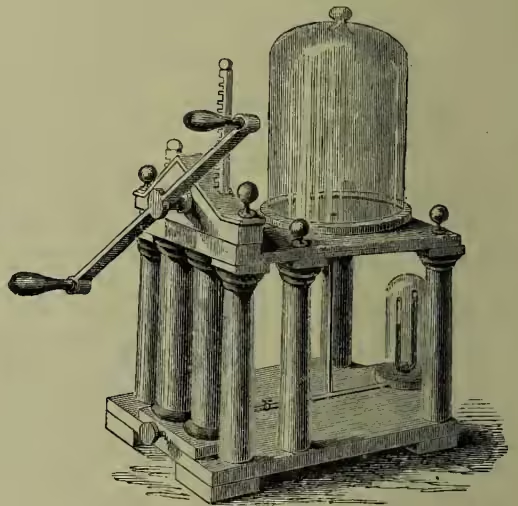
Air-pump, an instrument for removing the air from a vessel. The essential part is a hollow brass or glass cylinder, in which an air-tight piston is made to move up and down by a rod. From the bottom of the cylinder, a connecting tube leads to the space which is to be exhausted. This space is usually formed by placing a bell-glass, called the receiver, with edges ground smooth, and smeared with lard, on a flat, smooth plate or table. When the piston is at the bottom of the barrel, and is then drawn up, it lifts out the air from the barrel, and a portion of the air under the receiver, by its own expansion, passes through the connecting tube, and occupies the space below the piston, which would otherwise be a vacuum. The air in the receiver and barrel is thus rarefied. The piston is now forced down, and the effect of this is to close a valve placed at the mouth of the connecting tube, and opening inwards into the barrel. The air in the barrel is thus cut off from returning into the receiver, and, as it becomes condensed, forces up a valve in the piston, which opens outwards, and thus escapes into the atmosphere. When the piston reaches the bottom, and begins to ascend again, this valve closes; and the same process is repeated as at the first ascent. Each stroke thus diminishes the quantity of air in the receiver; but from the nature of the process, it is evident that the exhaustion can never be complete. Even theoretically, there must always be a portion left, though that portion may be rendered less than any assignable quantity; and practically the process is limited by the pressure of the remaining air being no longer sufficient to open the valves. The degree of rarefaction is indicated by a gauge on the principle of the barometer. By means of the partial vacuum formed by the air-pump, a great many interesting experiments can be performed, illustrating the effects of atmospheric pressure, and other mechanical properties of gases. The air-pump was invented by Otto Guericke (q. v.), 1654; and though many improvements and varieties of structure have been since devised, the principle of all is the same. Two barrels are generally used, so as to double the effect of one stroke. In some air-pumps, stop-cocks turned by the hand take the place of valves; and in others, the entrance of the connecting tube into the cylinder is so contrived that the valve through the piston is not required.