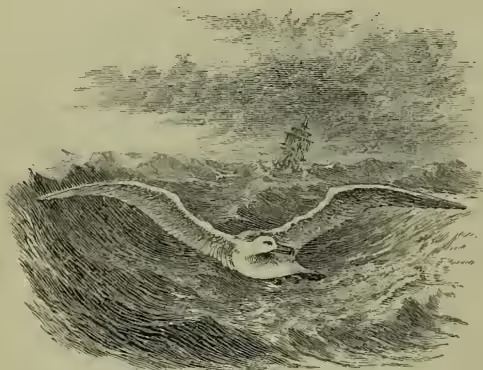
Albatross (Diomedea), a genus of web-footed birds, nearly allied to Gulls and Petrels. The strongly-webbed feet have no hind-toe or claw; the beak is as long as the head, and hooked at the point; the nostrils are borne on short horny tubes. The common or wandering albatross (D. exulans) is the largest of web-footed birds, measuring 4 feet in length, and from 10 up to as much as 17 feet in spread of wings. It weighs 15 to 20 pounds, or even more. The wings are, however, narrow in proportion to their length. This bird is often seen at a great distance from land, and abounds in the southern seas, particularly near the Cape of Good Hope, whence sailors sometimes call it the Cape Sheep. It often approaches very near to vessels, and is one of the objects of interest which present themselves to voyagers far away from land, particularly when it is seen sweeping the surface of the ocean in pursuit of fish and garbage. It seems rather to float and glide in the air, than to fly like other birds, for, except when it is rising from the water, the motion of its long wings is scarcely perceptible. It is affirmed by some to sail by setting its wings like sails, and to make headway against the wind without flapping. The plumage is soft and abundant, mostly white, dusky on the upper parts, with some of the feathers of the back and wings black. The bill is of a delicate pink, inclining to yellow at the tip. The Airsacs (q.v.) of the body are greatly developed. The albatross is extremely voracious; it feeds on fish, cuttle-fish, jelly-fish, &c. but has no objection to the flesh of a dead whale, or to any kind of carrion. Only one species is said to dive. It is not a courageous bird, and is often compelled to yield up its prey to sea-eagles, and even to the larger kinds of gulls. When food is abundant, it gorges itself like the vultures, and then sits motionless upon the water, so that it may sometimes be taken with the hand. Not unfrequently, however, on the approach of a boat, it disgorges the undigested food, and thus lightened, it flies off. The albatross has great powers of sustained flight. It often follows a ship for a considerable time, and it has been calculated that it may fly 720 nautical miles in a day. Its hoarse cry has been compared to that of the pelican, but is sometimes more suggestive of the braying of an ass. Its flesh is unpalatable. Albatrosses breed on solitary islands, like Tristan d'Acunha, and form a large, rough nest of earth, grass, and leaves. The single egg is 4 or 5 inches long, of a white colour, spotted at the larger end. It is edible, and is not unfrequently destroyed by the audacious skua. The nestling is white, the young somewhat brownish and of slow growth. There are seven species. One of these, the sooty albatross (D. fuliginosa), chiefly found within the antarctic circle, is called by sailors the Quaker Bird, on account of the prevailing brown colour of its plumage. Albatrosses appear in great numbers towards the end of June, about the Kurile Islands and Kamchatka. The Kamchadales take them by baited hooks, blow up the entrails for floats to their nets, and make tobacco-pipes and various domestic articles of the wing-bones.