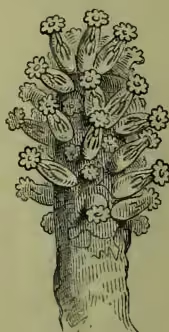
Alcyonium, or DEAD-MEN'S FINGERS, an exceedingly common cœlenterate of the sub-class Actinozoa, belonging to the same order (Alcyonaria) as the sea-pen, the red coral, the organ-pipe coral, &c. It is often found on the coast, in somewhat deep water, as an irregularly lobed mass of a white, creamy, or orange colour, attached to stones and shells. The whole varied clump, which is frequently about the size of a man's hand, whence the popular name, is not one animal, but a myriad colony. When undisturbed, the countless individual polyps may be seen projecting from the surface like miniature sea-anemones, about the size of a snail's horns (fig. 1). Each polyp consists of
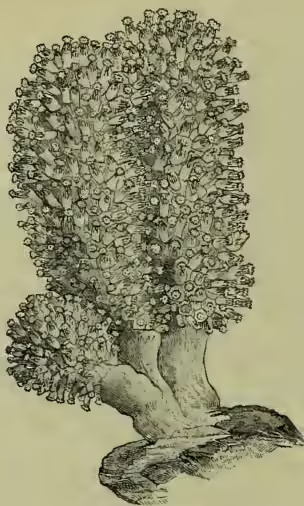
A stock of Alcyonium, showing individual polyps.
(After Johnston) a contractile tube, with a crown of tentacles round a slit-like mouth, and with the margin of the latter
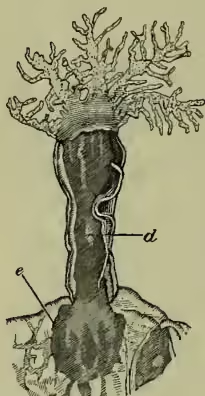
Longitudinal section of a single polyp at maximum extension, showing pinnate tentacle round mouth, neck region, protruded stomach tube (d), and lower gastral region with suggestion of mesenteries (e).
(Vogt and Yung.)
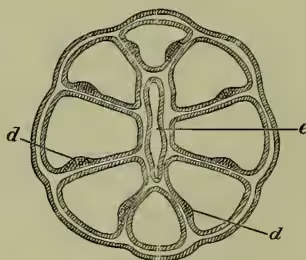
Cross section at level of mesenteries (from Vogt and Yung, after Hertwig), showing the body wall with its three layers, the radial mesenteries (d) with intervening chambers, and the central much narrowed stomach tube (e). prolonged inwards to form an inner stomach tube, connected with the outer wall by radial partitions
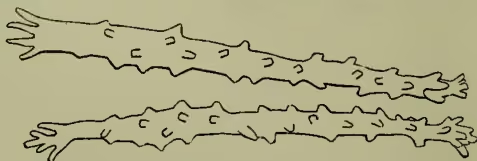
Large Spicules from Neck Region. (Vogt and Yung.) or mesenteries (fig. 2). So far the general structure is that of a sea-anemone, but in all Alcyonaria, and in Alcyonium among the rest, there are eight, and not six, tentacles and mesenteries, and the latter are never calcified. The expanded tentacles are seen to be irregularly pinnate, and bear the usual stinging cells. The neck region, below the base of the tentacles, is strengthened by the formation of knotted spicules (see fig. 4). In the lowest portion of the polyp, which always remains sunk within the stock, the eight mesenteries are very strongly developed, and leave only a small central tube (fig. 3). They exhibit certain coiled fringes, with an important digestive function, and further bear on their sides either eggs or sperms, as the colony happens to be male or female. All these individuals thus briefly described as minute sea-anemones are sunk in a clear, structureless mass, gradually formed as the connecting stock of the colony. The cavities of the individual polyps are continuous with canals traversing the stock, and these are again in connection with a finer network riddling and irrigating the entire mass. The common life of the colony is thus harmoniously sustained. The stock also includes a few muscle-fibres, and abundant irregular tiny spicules. Alcyonium is unisexual. Asexual multiplication by budding continually occurs; and this takes place not directly from individual polyps, but from the stock, by changes brought about through the above-mentioned canals. The common species is Alcyonium digitatum, and of this several varieties occur. A giant species (Alcyonium poculum), found on the coral reefs of Sumatra and in the neighbourhood of Singapore, attains nearly 3 feet in height and 18 inches in diameter. There are two other compound animals with somewhat similar names, Alcyonidium and Alcyonella, which used also to be ranked as zoophytes, but are now known to belong to the widely separated class of Polyzoa (q.v.). See ALCYONARIA, CELENTERATA, SEA-ANEMONE, ZOOPHYTE, &c.
Small Portion of a Colony.