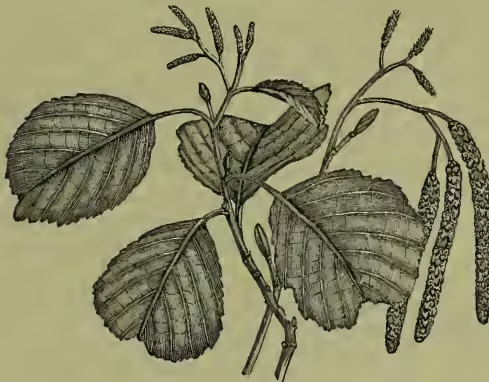
Alder (Alnus), a genus of plants of the natural order Betulaceæ (regarded by many as a sub-order of Amentaceæ; see also BIRCH). The genus consists entirely of trees and shrubs, natives of cold and temperate climates; the flowers in terminal, imbricated catkins, which appear before the leaves; the male and female flowers in separate catkins on the same plant; fruit, a compressed nut without wings.—The COMMON or BLACK ALDER (A. glutinosa) is a native of Britain, and of the northern parts of Asia and America. It has roundish, wedge-shaped obtuse leaves, lobed at the margin and serrated. The bark, except in very young trees, is nearly black. It succeeds best in moist soils, and helps to secure swampy river-banks against the effects of floods. It attains a height of 30 to 60 feet. Its leaves are somewhat glutinous. The wood is of an orange-yellow colour, not very good for fuel, but affording one of the best kinds of charcoal for the manufacture of gunpowder, upon which account it is often grown as coppice-wood. Great numbers of small alder trees are used in Scotland for making staves for herring-barrels. The wood is also employed by turners and joiners; but it is particularly valuable on account of its property of remaining for a long time under water without decay, and is therefore used for the piles of bridges, for pumps, sluices, pipes, cogs of mill-wheels, and similar purposes. The bark is used for tanning and for dyeing, also for staining fishermen's nets. It produces a yellow or red colour, or with copperas, a black colour. The leaves and female catkins are employed in the same way by the tanners and dyers of some countries. The bark is bitter and astringent, and has been used for gargles, and also administered with success in ague. The seeds are a favourite food of greenfinches. In boggy grounds the alder is often almost the only kind of tree, and in many parts of the Highlands, groups of alders are scattered over the lower and moister parts of the mountains. There are several handsome varieties of the common alder employed in ornamental planting, the most distinct being the GOLDEN ALDER, the leaves of which are bright golden yellow; and the CUT-LEAVED ALDER, with narrow, deeply incised leaves, and a much more graceful habit than the common form. The common alder ceases on the Swedish shore on the lower part of the Gulf of Bothnia.—The GRAY or WHITE ALDER (A. incana), a native of many parts of continental Europe, especially of the Alps, and also of North America and of Kamchatka, but not of Britain, differs from the common alder in having acute leaves, downy beneath, and not glutinous. It attains a rather greater height, but in very cold climates and unfavourable situations appears as a shrub. The wood is white, fine grained, and compact, but readily rots under water. The bark is used in dyeing.—A. eordifolia is a large and handsome tree, with cordate acuminate leaves, a native of the south of Italy, but found to be quite hardy in England. Some of the American species are mere shrubs. Several species are natives of the Himalayas.—The BERRY-BEARING ALDER, or BREAKING BUCKTHORN, is a totally different plant (see BUCKTHORN).