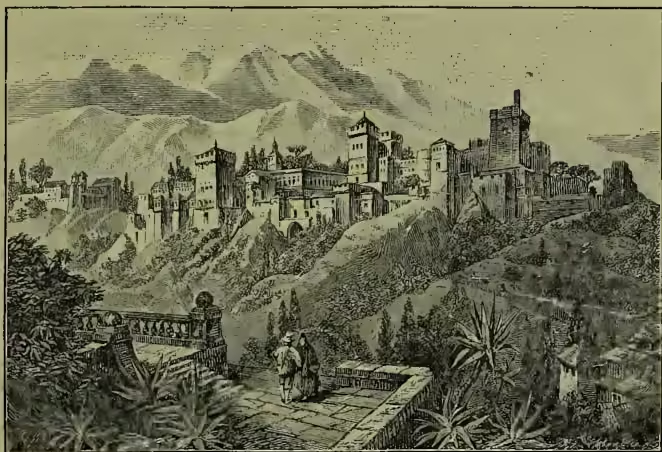
Alham'bra, a fortified suburb of Granada, which forms a sort of acropolis to the city, and in which stand the exquisite remains of the palace of the ancient Moorish kings of Granada. The name is a corruption of the Arabic Ka'at al hamra, 'the red castle.' It is surrounded by a strong wall, more than a mile in circuit, and studded with towers. The towers on the north wall, which is defended by nature, were used as residences connected with the palace. One of them contains the famous Hall of the Ambassadors. The remains of the Moorish palace are called by the Spaniards the Casa Real. It was begun by Ibn-l-ahmar (1248), and completed by his grandson, Mohammed III., about 1314. The principal decorator was Yusuf I., who regilt and repainted the palace; and even yet, in the dry climate of Spain, traces of his work have been preserved. The portions still standing are ranged round two oblong courts, one called the Court of the Fishpond, the other the Court of the Lions. They consist of porticos, pillared halls, cool chambers, small gardens, fountains, mosaic pavements, &c. The lightness and elegance of the columns and arches, and the richness of the ornamentation, are unsurpassed. The stone lacework scattered over all the building appears to those ignorant of Arabic mere quaint and beautiful scrolls, but is really a complex arrangement of Arabic poetry and verses from the Koran. The colouring, which often is marvellously preserved, employs only the three primary colours, among which the metallic blue greatly predominates, although the atmosphere has transformed much of it to green. Entrance is by a horseshoe arch, called by the Moors the 'gate of the law,' where the king sat to administer justice. Here, as almost everywhere else, the Moorish diaper-work is much broken, in this instance to make a niche for a wooden image of the Virgin. In the most beautiful room in the palace, the Hall of the Abencerrages (q.v.), to the beauty of colour and of ornamentation is added an arcade resting on light and graceful marble arches that run round the place. The most characteristic parts of the Casa Real have been reproduced in the 'Alhambra Court' of the Crystal Palace at Sydenham. A great part of the ancient palace was removed to make way for the palace begun by Charles V., but never completed. Since then it has suffered from the neglect and greed of successive governors; from the French, who blew up eight of its towers and tried to destroy the whole; from earthquake; and from fire (Sept. 16, 1890). There have been partial restorations (1845, 1862, &c.). See works by
Washington Irving (1832), Owen Jones (1848), and Murphy (new ed. 1856); see also ARABESQUE and ARABIAN ARCHITECTURE.