Ambulacral System

Chambers's Encyclopaedia, Volume 1: A to Beaufort, p. 212
Two diagrams illustrating the water-vascular system of a starfish. Diagram A is a cross-section of a starfish showing a central stone canal (s.c.) and five radial canals (r) that branch out to tube-feet (t) and lateral reservoirs (a). Diagram B is a diagrammatic plau of the system, showing the central canal (c) and the five radial canals (r) with their respective tube-feet (t) and reservoirs (a).
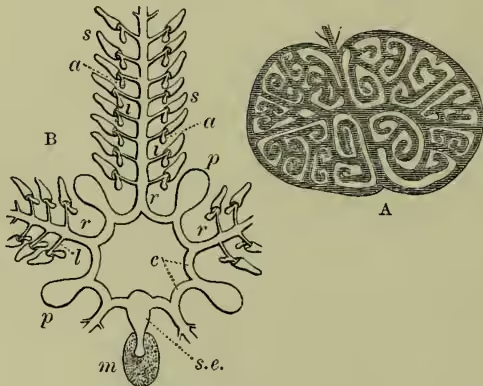
A, cross section of complex supply-canal of a starfish—the so-called stone-canal (after Gegenbaur). B, diagrammatic plau of system in a starfish (after Gegenbaur): r, radial canals, giving off branches, t, to suctorial tube-feet, s, with lateral and internal reservoirs or ampullæ, a; c, circular canal, with side reservoirs or Polian vesicles, p, with supply or stone canal, s.c., and special entrance or madreporic plate, m.

Ambulacral System (Lat. ambulare, 'to walk'), a term applied to a partly locomotor, partly respiratory, system in the Starfish (q.v.) group of animals. The term water-vascular is on the whole preferable. The system usually consists (1) of five radial canals, giving off tube-feet, which are generally suctorial; (2) of a circular canal surrounding the mouth, and uniting the oral ends of the five radials; and (3) of a special supply-canal, by which water enters the system. According to some, the water-vascular system of Echinoderms (q.v.) is essentially the same as that found in some worms.

Source scan(s): p. 0227