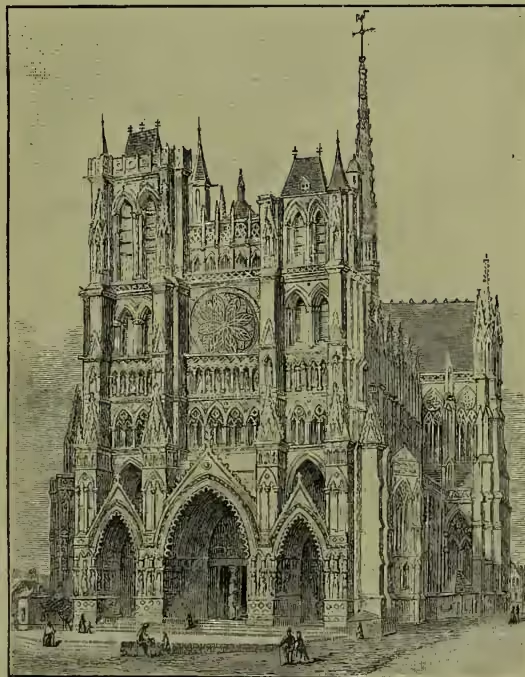
Amiens (ancient Samarobriva), an old French city, the capital once of Picardy, and now of the department of Somme, on the many-channelled, navigable Somme, 81 miles N. of Paris by rail. Its fortifications have been turned into charming boulevards, but it still retains its old citadel. The cathedral of Notre Dame is a masterpiece of Gothic architecture. Begun in 1220, or a little later than Salisbury cathedral, it is 452 feet long, and has a spire (1529) 426 feet high; but its special feature is the loftiness of the nave, 141 feet. In his little work called The Bible of Amiens, Ruskin says this church well deserves the name given it by Viollet-le-Duc, 'the Parthenon of Gothic architecture,' and affirms that its style is 'Gothic pure, authoritative, and unaccusable.' Other noteworthy buildings are the Hôtel-de-Ville (1600-1760), in which the Peace of Amiens was signed; the large museum (1864), in Renaissance style; and the public library, which was founded in 1791, and contains 70,000 volumes. Amiens has considerable manufactures of velvet, silk, woolen, and cotton goods, ribbons, and carpets. Peter the Hermit and Ducange were natives, and there are statues to both of them. The 'Mise of Amiens' was the award pronounced by Louis IX. of France, in 1264, on the controversy between Henry III. of England and his people as to the 'Provisions of Oxford.' The 'Peace of Amiens' (March 27, 1802) was a treaty intended to settle the disputed points between England, France, Spain, and Holland. By it, England retained possession of Ceylon and Trinidad, and an open port at the Cape of Good Hope; the republic of the Ionian Islands was recognised; Malta was restored to the Knights of St John; Spain and Holland regained their colonies, with the exception of Trinidad and Ceylon; the French were to quit Rome and Naples; and Turkey was restored to its integrity. In the Franco-German war, on 27th November 1870, General Manteuffel inflicted, near Amiens, a signal defeat on a French army 30,000 strong, and three days later the citadel surrendered. Pop. (1872) 61,063; (1886) 80,288; (1891) 76,069.