Ammonites, a genus of fossil shells, nearly allied to the recent genus Nautilus, being, like it, chambered and spiral. The molluscous inhabitant appears to have lodged in the last and largest chamber of the shell, the spaces left behind as it increased in size being successively converted into air-chambers, and all connected by a tube (siphuncle), so that the animal could at pleasure ascend or descend in the sea; whilst the transverse plates dividing the chambers gave strength to the whole structure without great increase of weight. In the Nautilus these dividing plates (septa) are simple and curved, and their edges (sutures) plain; but in the Ammonites the septa are often very complex, and the sutures zigzagged, foliated, or irregularly lobed. Ammonites have long been popularly called Cornua Ammonis, from a fancied resemblance to the horns on the sculptured heads of Jupiter Ammon. In former times they were ignorantly mistaken for petrified snakes; and impositions have been practised on collectors by adding to specimens nicely carved snakes' heads; whilst the general absence of heads was popularly accounted for by a legend of a saint decapitating the snakes, and turning them into stone. The family to which the Ammonites belong (Ammonitidæ) ranged from Palæozoic to Mesozoic times, and embraced a number of different forms. In some the shell is straight (Bactrites, Baculites); others are bent on themselves (Ptychoceras); some are curved (Toxoceras); then we have an elegant
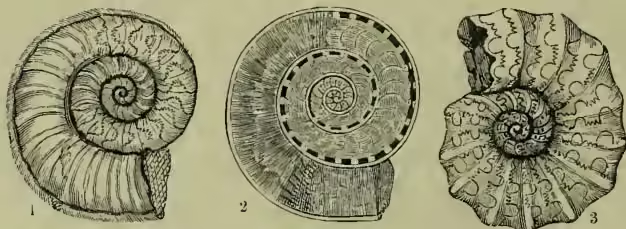
1, Ammonites obtusus; 2, section of Ammonites obtusus, showing the interior chambers and siphuncle; 3, Ammonites nodosus. spiral form (Turrilites); besides discoidal and semi-discoidal forms (Crioceras, Ancyloceras), and involute types such as Ammonites, Goniatites, Ceratites, &c. The most prominent Palæozoic representatives of the family are Goniatites and Clymenia. The Ammonites proper are Mesozoic forms, and are characteristic of the Jurassic and Cretaceous systems. In the former system especially, particular species distinguish particular zones, which renders the genus of great interest and importance to the geologist; for some of these zones are persistent over wide regions. The number of species of true Ammonites is very great, several hundred being known. They differ much in size—some being quite minute, while others are as large as cart-wheels.