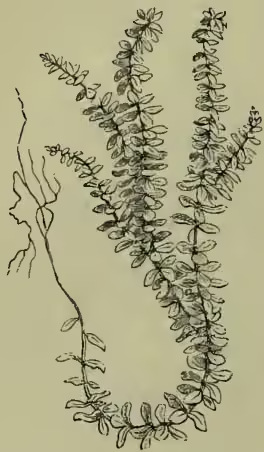
Ana'charis, a genus of plants of the natural order Hydrocharidæ, of which a species, Ana'charis alsinastrum (Elodea canadensis), has become naturalised in Britain. It is a native of North America, growing in ponds and slow streams; and is a dark-green, much-branched perennial, entirely floating under water. The plant was first found in Britain in 1842, by Dr Johnston, in the lake of Duns Castle; and again in 1847 in Leicestershire. The male flowers, rare as compared with the female flowers even in America, were unknown in Britain till seen by the late Mr David Douglas in a pond on the Braid Hills near Edinburgh, in August 1880 (see Science Gossip, Nov. 1880). The plant is now very abundant and troublesome in the Trent, Derwent, and other rivers; in fact, much more so than in America. Its rapidity of growth is extraordinary. Immense masses disfigure the shallows of the Trent, and cover the beds of the deeps. It strikes its shoots under the mnd in a lateral direction for six inches or a foot, and then rises and spreads. The stems are very brittle, and every fragment is capable of growing, so that the means usually adopted to get rid of it serve rather for its propagation. It appears that water-fowl are very fond of it; and by them, probably, its seeds may be conveyed from one river to another. It has been found that swans may be fed upon it with advantage, and its excessive growth kept down more effectually in this way than in any other. It seems to be an impediment to the progress of salmon ascending the rivers in which it occurs; but for some kinds of fish it probably affords both food and shelter. The manner of its introduc- tion into Britain is unknown, although it has been conjectured that it may have escaped from some garden-pond—a conjecture the more doubtful, from the distance between the localities in which it was first found; but its rapid increase is of great scientific interest, in connection with the important subject of the distribution of species. As being calculated to block up water-courses, the plant involves some serious economic considerations. It is remarkable that in North America, its native land, it never grows so as to block the rivers. The plant is also of interest to vegetable physiologists, since exhibiting peculiarly well, under moderate power of the microscope, the phenomenon of circulation of the protoplasm within the cells.