Analysis, in Chemistry, is the term applied to that department of experimental science which has for its object the chemical disunion or separation of the constituents of a compound substance: thus, the resolution of water into its components hydrogen and oxygen; of common salt into chlorine and sodium; of marble into lime and carbonic acid; of rust into iron and oxygen; of sugar into carbon, hydrogen, and oxygen; and of chloroform into carbon, hydrogen, and chlorine—are all examples of chemical analysis. This department of chemistry, therefore, takes cognisance of the breaking down of the more complex or compound substances into their more simple and elementary constituents, and is antagonistic to chemical synthesis, which treats of the union of the more simple or elementary bodies to produce the more complex or compound. Chemical analysis is of two kinds: Qualitative analysis, which determines the quality or nature of the ingredients of a compound, without regard to the quantity of each which may be present; and quantitative analysis, which calls in the aid of the balance or measure, and estimates the exact proportion, by weight or volume, in which the several constituents are united. Thus, qualitative analysis informs us what water, marble, common salt, &c. are composed of; but it remains for quantitative analysis to tell us that water consists of 1 part of hydrogen by weight united with 8 parts of oxygen; that marble is composed of 56 parts of lime, and 44 of carbonic acid; common salt, of parts of chlorine, and 23 of sodium; turpentine, of 30 carbon, and 4 hydrogen; chloroform, of 12 carbon, 1 hydrogen, and chlorine.
The divisions of inorganic (mineral) chemistry and organic (vegetable and animal) chemistry have led to a corresponding classification of chemical analysis into inorganic analysis, comprehending the processes followed and the results obtained in the investigation of the atmosphere, water, soils, and rocks; and organic analysis, treating of the modes of isolation, and the nature, of the ingredients found in or derived from organised structures—viz. plants and animals. Both departments afford examples of what are called proximate and ultimate analysis. Proximate analysis is the resolution of a compound substance into components which are themselves compound: thus, in inorganic chemistry, marble is resolved into lime (calcium united with oxygen) and carbonic acid (carbon with oxygen); whilst ultimate analysis comprehends the disunion of a compound into its elements or the simplest forms of matter: thus, lime into calcium and oxygen; carbonic acid into carbon and oxygen; water into hydrogen and oxygen. Organic chemistry affords still better examples of each class: thus, ordinary wheat-flour, when subjected to proximate analysis, yields, as its proximate components, gluten (vegetable fibrin), albumen, starch, sugar, gum, oil, and saline matter; but each of these proximate ingredients is in itself compound, and when they undergo ultimate analysis, the gluten and albumen yield, as their ultimate elements or constituents, carbon, hydrogen, oxygen, nitrogen, sulphur, and phosphorus; and the starch, sugar, gum, and oil are found built up of carbon, hydrogen, and oxygen.
Several other terms are in use in chemical treatises: thus, Gas analysis is applied to the processes employed in the examination of the various gases, and is every day becoming of more and more importance and interest. Metallurgic analysis includes the smelting of metallic ores, the assay of alloys of gold, silver, &c., and, in general, everything that pertains to the ultimate analysis of metallic ores and compounds. Agricultural analysis is restricted to the examination of manures, feeding-stuffs, and soils; Medical or Physiological analysis, to the investigation of blood, urine, and other animal fluids and juices, and the examination of medicinal compounds; whilst Commercial analysis is the term used where great accuracy or nicety of detail is not required in an analysis, but where the commercially important constituents alone are determined, as the separation and recording of the amount of phosphates, ammonia, and alkaline salts in a sample of guano; the total amount of saline matter in a certain water; the iron in an ironstone, the lime in a limestone, &c.
Generally speaking, there are three methods in use in analysis. These are the Volumetric, Gravimetric, and Spectroscopic. The Volumetric method submits the sample to certain characteristic reactions, employing as reagents liquids of known strength, called standard solutions; and by means of colour tests determines when a certain reaction is complete (see ALKALIMETRY). From the data thus obtained, it is possible to calculate the weight of substance present in the sample under examination. The Gravimetric, on the other hand, seeks to precipitate the metal or other substance in a convenient form for weighing, and makes constant use of the Balance. The Spectroscopic method depends on the separation of the different rays of light by means of a Spectroscope (q.v.). The substance under examination is usually volatilised in the flame of a Bunsen burner; and when the spectroscope is applied, coloured lines, varying with different substances, are seen across the spectrum, and enable the analyst to detect the most minute proportions with certainty.
COMMERCIAL or PHARMACEUTICAL ANALYSIS differs from inorganic or organic analysis, pure and simple, in dealing usually with complex mixtures, to which it is impossible to apply tests having a definite value as to the information they afford. Thus, a mixture of various inorganic salts can be analysed with certainty by proceeding on well-known rules; but, as yet, no one can be confident in the analysis of an unknown mixture containing, perchance, sirups or tinctures, along with infusions of animal or vegetable origin. To such a mixture it is necessary to apply many physical processes, in the hope that these will so separate the constituents as to render it possible to recognise them either by appearance, odour, or specific test. Thus it comes about that a knowledge of experimental physics, no less than of chemistry, is essential to the successful analyst. In the following paragraphs it is proposed to indicate the physical processes which let the most light into the darkness of an unknown commercial mixture, but for details the reader must consult a practical treatise.
Distillation.—The mixture being placed in a glass flask furnished with a thermometer, heat is applied, and the boiling-point noted. If this gradually rises, it indicates that the mixture contains more than one volatile liquid; and by separating the various portions of distillate, according to the temperature at which they pass over, it is often possible to obtain the samples sufficiently pure to be recognised. The term fractionation or fractional distillation is applied to this method. If a non-volatile residue remains in the flask, it must be examined from other points of view. Thus, substances may be divided into: (1) Volatile—e.g. alcohol, ether, &c.; (2) Not volatile except along with other bodies—e.g. glycerine, which cannot be distilled alone, but passes over along with water vapour; (3) Non-volatile—e.g. fixed oils, olive, rape, &c.
Solution.—This may be applied in two ways. The solvent, be it alcohol, ether, water, or other liquid, is shaken with the substance under examination, and in many cases dissolves one ingredient, to the exclusion of others. Thus, it is desired to know how much oxide of iron is present in a sample of polishing-paste. Treatment with ether dissolves the fatty substances, and leaves the oxide free to be estimated in the usual manner. The other way consists in shaking ether or chloroform with the watery solution of the substance, when it will be found that some of the ingredients (more soluble in these liquids than in water) have been dissolved, and may be obtained on evaporation.
Rotation of the Polarised Ray.—It is found that many substances, and even the solutions of optically active compounds, have the power of rotating the plane of polarisation of a ray of light, and in many cases the extent of this rotation is sufficient to detect not only the presence but even the proportions of the substance to which it is due. Such bodies as sugar, turpentine, alkaloids, camphor, albumen, &c. exert this power.
Fluorescence (q.v.) is often of great assistance in commercial analysis. Thus, it is possible to pronounce the intense bitterness of a sirup to be due not to quinine, but to some other bitter, if no fluorescence is apparent; while the green fluorescence often noted on pens is a clear indication that the ink employed contains some colouring matter other than indigo, probably an aniline dye.
Melting and Solidifying Point.—The knowledge of this is of much importance, as, for example, in a case where common or other resins had been mixed with small pieces of amber. In such a case, the more fusible resin would melt and run away, leaving the bodies of higher melting-point. In other cases where no separation takes place, as with various kinds of wax, it enables the presence of paraffin or other foreign bodies to be detected. Adulteration of essential and fixed oils may frequently be exposed by this simple test.
Ignition on a piece of platinum or a porcelain dish is the simplest method of removing organic matter from inorganic, the latter usually remaining behind as a residue.
The specific gravity, the colour, odour, taste, crystalline form, solvent powers, and inflammability are all important factors in commercial analysis; while even such an apparently simple property as the size of drop which falls from a vessel containing the liquid, is in some cases the crucial test which decides as to the purity or otherwise.
The spectroscope is a powerful instrument, especially in pharmaceutical analysis. When a glass vessel, containing a tincture of a drug, is examined through the spectroscope, absorption spectra are seen (see SPECTRUM), and as these are characteristic of various herbs, they have been much used in recognising their presence in mixtures.
Sublimation.—When very carefully heated under a watch-glass, many alkaloids and other active principles yield sublimes having a characteristic crystalline form, which is easily recognised when examined under the microscope.
Microscopical Examination is a sine qua non when flour, or indeed any organic powder, is in question. Under the microscope, the different forms of starch are easily recognised, and by counting the granules of each variety in the visible field, one can arrive at the approximate proportions of each that are present.
Such, then, are some of the most valuable methods of commercial analysis; and in the examination of an unknown substance, many or all of them must be tried, the ingenuity of the chemist having here unbounded scope. For instance, supposing a mixture contained olive-oil, chloroform, glycerine, alcohol, and flour, the following course (capable of infinite variation) would soon lead to the detection of its ingredients. The microscope would at once pronounce as to the name of the starch, and after filtration through paper, the liquid being placed in a flask and heated, the chloroform and alcohol would pass over into the receiver. The residue of glycerine and olive-oil being non-miscible, could be readily separated into its two constituents, each of which could be recognised by specific gravity, taste, or solubility, as well as other more chemical tests. The chloroform and alcohol, on being poured into water, would at once separate into two layers, the lower of chloroform with a trace of alcohol, the upper of water and alcohol with a trace of chloroform. Numerous precautions are of course necessary to make sure that no substance remains undetected, and in many cases the chemist tries to re-combine his mixture from the separate pure ingredients, so as to give greater certainty to his conclusions. Such a method is called the synthetic one. See ADULTERATION.
ORGANIC ANALYSIS.—The analysis of that class of substances commonly known as organic compounds, is a process which requires to be varied very considerably, according to the nature of the compound to be analysed, and according to the elements which it contains. Every so-called organic compound contains carbon as one of its essential constituents, but no sharp distinction, except of a purely artificial kind, can be drawn between organic and inorganic carbon compounds. Those elements which, besides carbon, are prominently conspicuous in the composition of the majority of undoubtedly organic compounds, are hydrogen, oxygen, and nitrogen. Many hundreds of compounds exist which contain only carbon and hydrogen; some very large classes of compounds contain oxygen in addition to these two; while compounds containing nitrogen, in addition to hydrogen, or oxygen, or both, are also very numerous. Besides these large classes, however, many organic compounds exist, containing sulphur, phosphorus, chlorine, bromine, iodine, or other non-metallic element, or almost any of the known metals.
When a new compound has been isolated in what is believed to be a pure state, it is of the utmost importance, from a chemical point of view, that its qualitative and quantitative composition should be determined. From its origin, it is often possible to say what elements it is likely or unlikely to contain, but a qualitative search must be made to prove the presence or absence of particular elements. In order to test for carbon, and simultaneously for hydrogen, the substance is mixed with black oxide of copper (cupric oxide), which, as well as the substance itself, must be quite free from moisture, and then heated to redness in a hard glass tube. Carbon is oxidised, by the oxygen of the cupric oxide, to carbonic acid, which may be recognised by passing it through a small bent tube, containing in the bend a few drops of lime-water, when a white precipitate of calcium carbonate is produced; hydrogen is also oxidised, forming water, drops of which will condense in a cold glass tube placed in front of the one containing the lime-water. The test usually employed in searching for nitrogen, is to heat a small quantity of the substance with a fragment of sodium in a narrow glass tube, then to grind up the tube and its contents under water, and to seek in the solution thus obtained for the presence of sodium cyanide. The presence of oxygen may be ascertained by heating the substance to be tested, to a red heat in a current of pure and dry hydrogen gas, and observing the formation of water. The methods of testing for other elements cannot be discussed at length, but the general rule is to destroy the organic matter, either by heating alone, or by the action of powerful oxidising agents, such as nitric acid, and then to test by suitable means, as in inorganic analysis, for the products formed by such heating or oxidation.
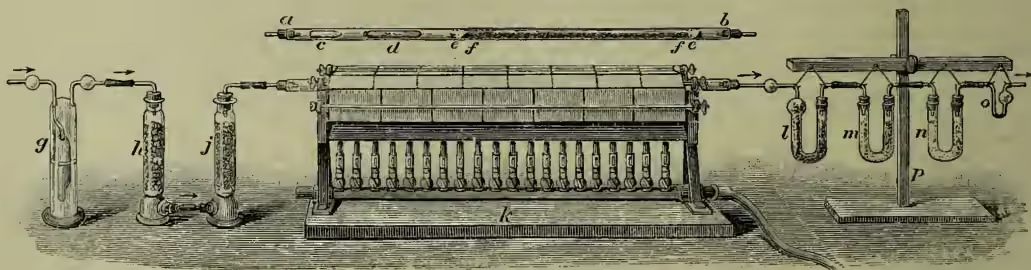
The simplest case of the quantitative analysis of an organic compound is that when the compound contains carbon and hydrogen only, or these two along with oxygen. In such a case, the method almost universally adopted now is what is known as the open tube combustion method, or the combustion of the substance in a tube contain- ab is the combustion tube shown separately, the ends being fitted with rubber stoppers, bored for the introduction of glass tubes c; f is cupric oxide confined by stoppers of asbestos at ee; d is the 'boat' to contain the substance, and c a piece of glass to narrow the air passage and prevent backward diffusion; k is the gas furnace; g, h, and j contain solution of caustic potash, pieces of solid caustic potash, and pumice-stone soaked in sulphuric acid respectively, to purify and dry the current of air; the stand p supports the tubes l, m, and n, which absorb the products of the combustion; o contains a drop of strong sulphuric acid, and serves to indicate the rate of exit of gas bubbles. ing red-hot cupric oxide, through which a current of air or oxygen is passed during the operation. For the purpose of such a combustion, a tube of highly infusible glass is employed, some thirty inches long, open at both ends, and having an internal bore of about half an inch. This tube is filled, from the middle to within two inches or so of one end, with coarsely powdered cupric oxide, which is held in its place by two plugs of not too tightly packed asbestos. The ends are fitted with stoppers of red rubber, perforated so as to admit of the introduction of narrow glass tubes. Thus arranged, the tube is placed horizontally, with the ends projecting about two inches at each side, in a gas furnace (which is the modern representative of the old charcoal furnace at one time exclusively used), and carefully heated up to bright redness, while a current of dry air or oxygen is passed slowly through it, entering at the end which is not occupied by the cupric oxide, and passing out again at the other end. This preliminary ignition is to remove all traces of organic matter and moisture from the tube itself, and its contents, and it is continued for half an hour or longer. The current of air or oxygen is purified from traces of carbonic acid, and from aqueous vapour, by passing it first through strong solution of caustic potash contained in a washing-bottle, next through a tube containing pieces of solid caustic potash, and finally through one or more tubes containing fragments of pumice moistened with strong sulphuric acid. When the ignition has been continued for a sufficiently long time, part of the gas is turned out, so as to allow the front part of the tube to cool, the cupric oxide, however, being kept hot. After this, the weighed tubes, which are to collect the products of the combustion, are fitted air-tight to the exit end of the combustion tube. These consist of, first, a U tube of special shape, packed with fragments of pumice moistened with strong sulphuric acid, in which the whole of the water is condensed and collected; and second, one or more U tubes containing granulated soda-lime* in which carbonic acid is absorbed. Before escaping from the last soda-lime tube, the unabsorbed gases pass through a short layer of fragments of dried calcium chloride, to retain water vapour liberated by the action of carbonic acid on the soda-lime. When the front part of the tube is nearly cold, the india-rubber stopper is removed, the weighed quantity of the substance to be analysed, contained in a platinum or porcelain 'boat,' is introduced into the tube, and the stopper rapidly replaced. A slow current of dry air being again passed through the tube, the substance is then very slowly and cautiously heated, so as to cause it to burn slowly; and, by degrees, the whole of the cool part of the tube is heated, eventually to bright redness, and this heat is maintained until the substance is completely burned, oxygen being passed through to complete the process if necessary. The products of combustion are entirely swept out of the combustion tube, and into the weighed tubes, by continuing the air-current for some time after the substance is entirely burned. These tubes are then detached, allowed to cool, and weighed. The percentages of hydrogen and carbon in the substance are calculated from the weights of water and carbonic acid respectively obtained.
As a rule, the percentage of oxygen contained in an organic substance is estimated by difference. Several methods for the direct determination of oxygen have been proposed, but none of these have come into common use.
The determination of nitrogen is carried out in two ways, depending on the nature of the substance to be analysed. One method is to convert the nitrogen into ammonia, by ignition with soda-lime in a tube closed at one end, the quantity of ammonia being subsequently determined by one of several methods. In other nitrogen compounds, it is not possible to convert the whole of the nitrogen into ammonia in this way. In such cases, a combustion of a special kind has to be made, with cupric oxide, in a tube closed at one end, when the
* Soda-lime is a mixture of sodium and calcium hydrates, prepared by slaking quicklime with caustic soda solution, and drying up the product.
nitrogen is obtained in the uncombined state as gas, and its volume is measured. From the observed volume, the weight can be calculated by a simple formula.
The methods employed to determine the quantities of elements less frequently occurring as constituents of organic compounds, such as sulphur, phosphorus, iodine, &c., are very numerous, and some are very complicated; hence they could not profitably be discussed here in any detail. Suffice it to say, as has been said already under the qualitative testing, that the first step is almost invariably one involving the destruction of the organic compound as such, by some oxidising process, after which the products can be treated exactly as would be done in the case of inorganic quantitative analysis.