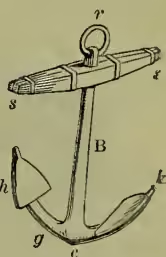
Anchor, an implement for retaining a ship in a particular spot, by temporarily chaining it to the bed of a sea or river. Many forms of anchor were made by the ancients; some were merely large stones; others, crooked pieces of wood, weighted to make them sink in water, the earlier ones acting mainly as weights, and holding the vessel by their own inertia instead of hooking into the ground. The first iron anchors are supposed to have been used by the Greeks. As originally made, the anchor had only one fluke or arm for penetrating the ground, and no stock. A large-sized modern anchor, irrespective of recent improvements, comprises the following parts (see fig. 1): The vertical or supporting beam of the anchor is the shank, B; at the upper end of it is a ring, r, or a shackle, and just below the ring is a transverse piece called the stock, s s; the other extremity is the crown, c, from which branch out two arms or blades, g, in directions nearly at right angles to that of the stock; each arm spreads out into a broad palm or fluke, h, the sharp extremity of which is the peak or bill, k. When the anchor is let go from the ship's side, the crown first strikes the ground; it then falls over in such a manner that one end of the stock rests upon the ground; and the subsequent movements of the ship and the cable cause one or other of the flukes to enter the ground, and take fast hold.
The number of anchors in British ships-of-war varies according to the size of vessel, and the character of the service intended. A large ironclad carries 8 anchors—2 'bowers,' 2 'sheets,' 1 'stream,' 1 'stern,' and 2 'kedges.' Smaller vessels have fewer and smaller anchors; and the 'stream'-anchor of a large ship may conveniently serve as the 'bower' for a smaller, the difference between bower, sheet, and spare anchors being rather in size than in design. Lloyd's rules prescribe the number and weight of anchors which must be carried by ships of different sizes registered in their list, as well as the size and length of their cables, hawsers, and warps.
Some of these particulars are given in the table:
| Ship's Tonnage. | Anchors. | Stud-Chain Cables. | |||||
|---|---|---|---|---|---|---|---|
| No. of Bowers. | No. of Others. | Weight of each Bower.* | Admiralty Test. | Size (Minimum). | Length. | Admiralty Test. | |
| lbs. | tons. | tons. | |||||
| 100 | 2 | 2 | 5 | 7 | 1 | 135 | 11 |
| 200 | 3 | 2 | 8 | 10 | 1 | 165 | 20 |
| 500 | 3 | 3 | 18 | 19 | 1 | 240 | 37 |
| 1000 | 3 | 3 | 30 | 28 | 1 | 270 | 55 |
| 1400 | 3 | 3 | 34 | 31 | 1 | 270 | 63 |
| 2000 | 3 | 3 | 40 | 35 | 2 | 270 | 76 |
| 2500 | 3 | 3 | 42 | 37 | 2 | 300 | 86 |
| 3000 | 3 | 3 | 45 | 39 | 2 | 300 | 96 |
* Excluding stock.
Steamers are only required to carry the anchors and cables which belong to a sailing-vessel of two-thirds their total tonnage.
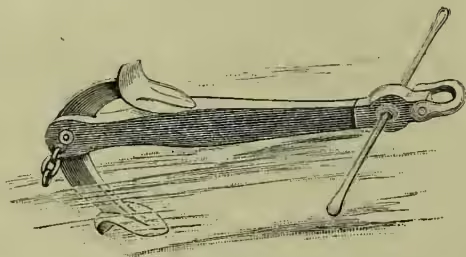
Many improvements in the shape and construction of anchors of the standard type have been introduced during the past forty or fifty years, of which Rodgers' and Lenox's anchors are the best known; and latterly several novel and improved forms have received extensive adoption—especially in vessels for merchant service. One of the most important changes is that effected under Rodgers' patent of 1838, also known as Honibal's. The arms, instead of being solidly connected to the shank, are movable in relation to it. They pivot about a bolt passing through the crown-piece of the arms and the end of the shank, the latter being fork-shaped to receive the former. The principle will be understood from fig. 2, repre- senting an early form of Trotman's anchor, which is an improved modification of Porter's, the difference mainly consisting in the shape and disposition of the flukes and their horns or toggles. The advantages of this anchor over those of ordinary make are very considerable. Besides the increased holding-power due to the pivoting of the arm, and diminished chance of the anchor lodging on its stock end, there is less danger of its 'fouling'—in other words, of the cable becoming entangled with the upper fluke—because of the reduced height that the fluke projects above ground when the lower one has taken hold. The construction of the anchor is of course more complex than the ordinary solid anchor, and its peculiar form makes it somewhat awkward to 'fish,' and still more difficult to 'sweep,' in the event of the cable parting. On the other hand, it is very conveniently stowed on ship-board. In 1852 the Admiralty appointed a committee to make an elaborate trial of a large number of anchors; and that which obtained the highest place was Trotman's.
An anchor radically different is that patented by Martin, a Frenchman. It is self-canting, and both flukes are utilised at one operation for maintaining a hold of the ground. The arms, which are in one piece, are fitted through a hole in the crown end of the shank, which is increased in area for the purpose, and they are free to swing through a range of 30° relatively to the shank. Thus, on whatever side the anchor falls, the arms by their own weight and the pull of the cable are made to take hold of the ground at once. The stock, which is flat and broad, is fitted across the shank in the same direction as the arms. This anchor is simple in construction, being made in three separate forgings, without a weld, and is easily housed. The Admiralty—who favour this anchor for special types of vessels—allow a reduction of 25 per cent. in weight; using an 80-cwt. Martin's anchor (with stock) where a 90-cwt. (with stock, 108 to 112 cwt.) Admiralty or Rodgers' anchor would be fitted.
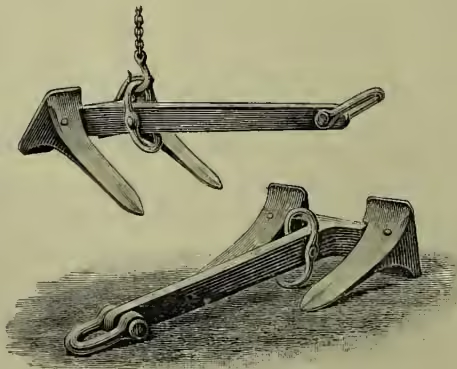
Several anchors which appear to be modifications of Martin's have recently been introduced. One of these being pretty extensively adopted is Wastenay Smith's stockless anchor (shown by fig. 3). Like Martin's, it is self-canting, and both flukes take hold of the ground at once, no matter how the anchor falls. The stock being dispensed with, a large saving in weight is effected.
A recent innovation, for which anchors of the type just described readily adapt themselves, is the formation of a recess in the ship's side at the mouth of the hawse-pipes, in which to house the anchors instead of hoisting them on deck—an arrangement which offers very considerable advantages over the ordinary system.
Till the introduction of the steam-hammer, anchor-making was the most formidable smith's work, on account of the great size and weight of the pieces of iron. The anchor-smiths wielded the most ponderous sledge-hammers known to our artisans. An even greater recent change is that crucible cast-steel is now taking the place of wrought-iron for anchors. At some of the government dockyards, anchor-making is conducted on a great scale; but the larger portion of the supply for the navy is obtained by contract with private firms.