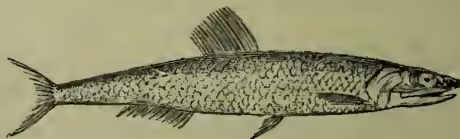
Ancho'vy (Engraulis encrasiicholus), a small bony fish of the herring family (Clupeidae), of some importance as a food-luxury. It may attain a length of eight inches, but usually measures only about a finger's length. The snout of the pointed head projects considerably beyond the lower jaw, the abdomen and sides are covered with large silvery scales, the back has a greenish-blue colour, the tail is deeply forked. The species occurs abundantly round the European coasts, especially in the southern and Mediterranean region, while the genus is represented in all the warmer waters. It would seem to have been formerly more abundant in the British seas, as several acts of parliament in the reign of William and Mary regulated the anchovy fisheries. It seems, however, that the fishery, rather than the supply of fish, has declined. In spring, shoals of anchovies leave the deep seas and approach the shore for spawning purposes. They are fished at night; attracted by lights, and captured by the seine net. They are salted, and used for sauces, &c. Three species are found in North American Atlantic waters, and four on the Pacific side. The Romans seem to have used them for the esteemed fish sauce called garum, and the Indian species (E. brownii) is used for making the condiment called Red Fish.