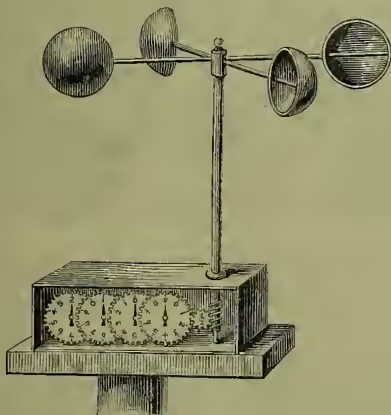
Anemometer (Gr. anemos, 'the wind,' and metron, 'a measure'; Fr. anémomètre, Ger. Windmesser), an instrument for measuring the pressure or velocity of the wind. The simplest anemometer is that which is generally known as Robinson's hemispherical-cup anemometer (see fig.), invented by Dr Robinson of Armagh in 1846. It consists of four hollow hemispheres or cups fixed to the ends of two horizontal iron rods crossing each other at right angles, and supported on a vertical axis which turns freely. Experiments show that the cups revolve with about a third of the wind's velocity, and the instrument is so constructed that 500 revolutions are made whilst a mile of wind passes over it. The revolutions are registered by a system of wheels similar to those of an ordinary gas-meter. The difference between two readings gives the number of revolutions passed over during the intervening time, from which the miles can be calculated and the rate per hour.
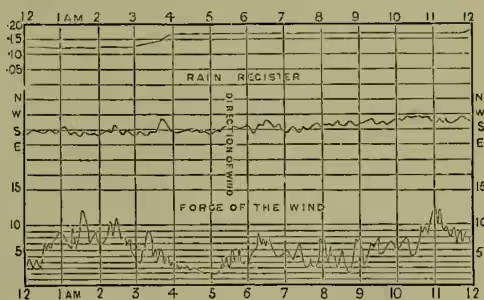
Pressure anemometers are of very great import- ance in meteorological observatories and for engineering purposes. Of these, one of the best known is that invented by Osler. In this instrument, the force of the wind is ascertained in a different way from the hemispherical-cup anemometer. A brass plate one foot square is suspended by means of springs, and being attached to the vane of the instrument, is maintained at right angles to the direction of the wind. This plate, by the action of the wind, is beaten back upon the springs, and in so doing, causes a pencil to move backwards and forwards on a sheet of paper placed below it. This sheet of paper is made to pass under the pencil in a direction at right angles to its oscillation; and by means of clockwork, moves at a uniform rate, so that the force of the wind at any particular time of the day is recorded. A pencil in connection with the vane, and moving in the same transverse line as the former, records the changes in the direction of the wind; and usually a third pencil, guided by a rain-gauge, registers on the same sheet the quantity of rain that has fallen. The preceding sketch, taken from the first half of a daily register-sheet, gives an idea of the kind of record made by an Osler's anemometer. The space between two upright lines indicates an hour; that between two horizontal lines, in the rain-register of an inch of rain, in the direction of the wind two cardinal points, and in the force of the wind 1 lb. of pressure on the square foot.
Thus, on the day in which these lines were traced, there was in the rain-register, brought over from the former account, between '10 and '15 of an inch; and during the twelve hours, the pencil had only risen one space, indicating a fall of '05, or of an inch, almost entirely between the hours of 3 and 4 in the morning, and immediately before 12 in the day. If the day had been very rainy, and the pencil had risen to the top of the register, it would have fallen immediately to the bottom of it, and begun a new account; and it might have done so several times in the course of the twelve hours. This would have been effected by the mechanism connected with the rain-gauge, which enables the gauge to empty itself each time that the pencil reaches the top of the rain-register. As regards the direction of the wind, it was, during the first six hours, south, veering slightly towards the east; and for the last six hours, it was tending decidedly towards the west, being between 10 and 11 nearly west. From the line marking the force of the wind, it will be seen that the day was stormy. Between 1 and 2, and at 11, the wind was blowing a very high gale, producing a pressure of upwards of 12 pounds on the square foot; and between the hours of 4 and 5, there was a decided lull, the wind being brisk, but not stormy (2 to 3 lb.). Both the hemispherical-cup anemometer and the pressure anemometer are equally indispensable in fully equipped observatories. The former registers only the amount of wind which passes over the place, but does not register the force of those sudden and instantaneous gusts of wind to which storms and hurricanes owe their destructive energy. It must, however, be added that a tolerably correct means of registering the force of high winds remains yet to be found out.
In Lind's anemometer, the wind, entering the mouth of one of two upright glass tubes, connected below, depresses the column of water contained in the one tube, and raises proportionately that in the other. This anemometer gives only the roughest results.
The following table gives approximately the relation of the height of the water in the anemometer, to the force and velocity of the wind in winds of different characters :
| Height of Water. | Pressure per Square Foot. | Velocity per hour. | |
|---|---|---|---|
| Feeble Wind..... | inches. | lb. | miles. |
| Fresh Breeze..... | " | " | " |
| Very Strong Wind..... | 1 " | " | " |
| Tempest..... | 4 " | " | 65 " |