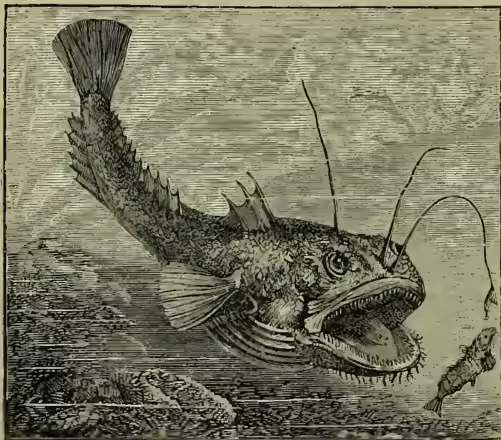
Angler (Lophius piscatorius), a fish not uncommon on British shores, and sometimes called the Fishing-frog, sometimes, from its ugliness and voracity, the Sea-devil. It usually measures three feet or more in length. The head is enormously large, depressed, and spinous; the mouth is of similar proportions (whence the Scottish name Wide Gab), and furnished with many sharp curved teeth, and with numerous worm-like lip-processes or barbules. The lower jaw is considerably longer than the upper. The body is narrow in comparison with the great breadth of the head, and tapers rapidly to the tail. The whole fish is covered with a loose skin, almost without scales. There are two dorsal fins, which are spinous, and three anterior rays, regarded as belonging to the first dorsal, and freely articulated to the head, which are with great probability supposed to serve the animal as delicate organs of touch. The nostril tube is elongated into a membranous stalk, capable of spreading out like a cup at the upper end, and of being moved in every direction by a very numerous set of muscles; the bottom of the cup being divided into projecting leaflets, on which the olfactory nerve is finally distributed. The angler lives very much along the bottom, and, like the angel-fish, is said to attract its prey by dislodging worms from the sand. The dorsal filaments on the back of the head have been credited with attractive functions from before the time of Aristotle. The fish is exceedingly voracious, scores of undigested herrings, &c. having been frequently found in a single stomach. It is common in all North Atlantic coast waters. Other species are known in Mediterranean, Pacific, and South Atlantic waters.—The genus Lophius belongs to the order Acanthopterygii, and to the family Pediculati, remarkable for the elongation of the carpal bones, so as to form a distinct wrist, to the extremity of which the pectoral fin is articulated. By means of this development, these fishes are able to leap up suddenly to seize the prey which they observe above them; and some of them can hop about upon seaweeds or mud from which the water has retired. They do not suffer so quickly as most other fishes from being out of the water, their gill-opening being very small, and an angler has been often known to devour flounders or other fish which have been caught along with it. Most of the Pediculati are tropical.