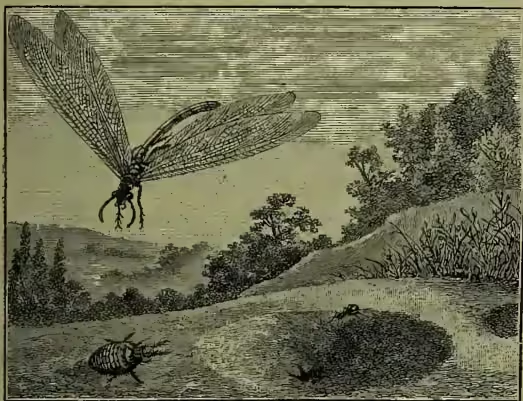
Ant-lion, the larva of an insect (Myrmeleon) of the order Neuroptera, remarkable for the ingenuity of its insect-catching habits. It inhabits sandy districts, is not known in Britain, and is more common in the south of Europe than in the north. Some species are common in North America. The perfect insect is about an inch long, and has a general resemblance to a dragon-fly. The grayish-yellow larva is rather more than half an inch long; it has a stout hairy abdomen, and a small head, which is furnished, however, with two very large incurved mandibles. It has six legs, but is incapable of rapid locomotion, and generally jerks itself backwards. It feeds upon the juices of insects, especially ants, in order to obtain which it cleverly excavates a funnel-shaped pitfall in sandy ground, and lies in wait at the bottom, often with all but its mandibles buried in the sand. When insects approach too near to the edge of the hole, the loose sand gives way, so that they fall down the steep slope. If they do not fall quite to the bottom, but begin to scramble up again, the ant-lion throws sand upon them by jerking its head, and thus brings them back. It employs its head in the same way to eject their bodies from its pit, after their juices have been sucked, and casts them to a considerable distance; and by the same means throws away the sand in excavating its hole, first ploughing it up with its body, and then placing it upon its head by means of one of its fore-legs. It always begins by working round the circumference of its future hole, and gradually narrows and deepens it; turning quite round after each time that it works round the hole, so as to employ next time the fore-leg of the other side. When it meets with a stone which it cannot remove, it deserts the excavation and begins another. The pit is rather more than two inches deep. After about two years the larva spins its cocoon. The habit is seen at a lower stage of evolution in some species which simply bury themselves in the sand without making any pitfall.—The name of Ant-lion (Myrmekoleon) was long given to a fabulous beast, supposed to be the offspring of a lion and a female ant, and participating in the form and qualities of both parents.