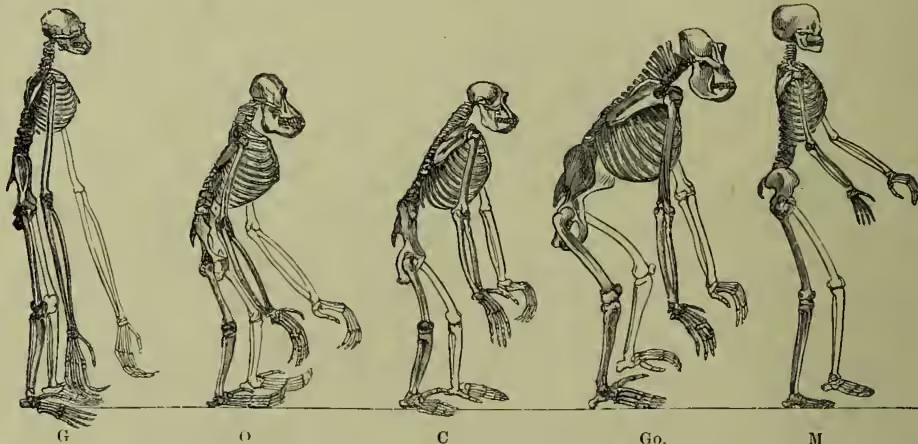
Anthropoid Apes, the highest and most man-like monkeys, including Gorilla, Chimpanzee, Orang-utan, Gibbon, and several other species. They are technically described by the Linnaean title Anthropomorpha, and readily distinguished, as tail-less, semi-erect, and long-armed, from the dog-like apes (Cynomorpha), which have also a narrow partition between the nostrils (Catar- rhini), and also inhabit the Old World. With the decidedly lower flat-nosed New-World monkeys, or Platyrrhini, there is no possibility of confusion. The anthropoid apes are all arboreal, and inhabit Africa, South-eastern Asia, and the Malay Archipelago. In all, about a dozen species have been described with more or less definiteness. The family is of special interest and importance in connection with the views held by evolutionists as to the descent of man. It is recognised by anatomists that all the attempts to establish a fundamental distinction, on anatomical grounds, between the physical structure of the higher apes and that of man are futile. Generic differ- ences, indeed, there are in abundance, but these establish only a difference of degree, and not of kind. Thus, in man, the great toe is not opposable to the others for grasping purposes, the angle between the face and the top of the skull does not exceed , the teeth form an uninterrupted series, and so on; while the strong spines on the back of the gorilla's neck, the very marked eyebrow ridges in gorilla and chimpanzee, the especially long arms of the gibbon, and the protruding jaws of all the anthropoids, are equally characteristic adaptations to different ways of life. Even in the minutiae of blood-vessels, muscles, nerves, and brain-convolutions, impartial observers have demonstrated the closest resemblance. The differences of structure between the lowest monkeys and the higher are far greater than those between man and any anthropoid ape, the resemblances being especially obvious when young forms are compared. In their expressions of cerebral activity, whether intellectual or emotional, the anthropoids come in some respects very near the lowest human tribes.
On the other hand, while it is impossible to establish any fundamental distinction in physical structure between Homo and the Anthropomorpha, there is among evolutionists an equal consensus of opinion as to the impossibility of regarding an ape of any existing anthropoid species as in the direct line of human ancestry. As regards brain-structure, the most man-like ape is the orang, while the chimpanzee has the most closely related skull, the gorilla the most human feet and hands, the gibbon the most similar chest. The study of anthropoid fossils has not yet discovered the remains of any form which can be accepted as the 'missing link,' although extinct anthropoids, such as Pitheanthropus (q.v.), serve greatly to lessen the distance to be bridged over. The reader should consult Darwin's Descent of Man, Hæckel's Anthropogeny, Huxley's Man's Place in Nature, and Hartmann's Anthropoid Apes (Internat. Sc. Series), where abundant references will be found. See also EVOLUTION, MAN (Descent of); and APE, CHIMPANZEE, GIBBON, GORILLA, MONKEYS, ORANG.