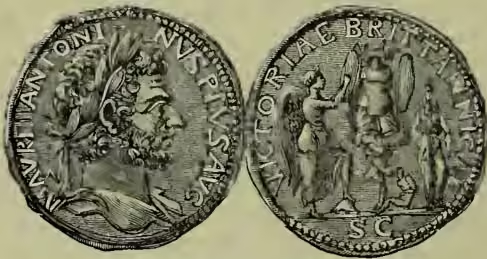
commemorative of his victories in Britain.
(From a coin in the British Museum.)
Antoninus Pius, TITUS AURELIUS FULVUS, Roman emperor (138-161 A.D.), was born in the reign of Domitian, in the year 86 A.D. His family came originally from Nemausus, now Nimes, in Gaul. Antoninus inherited great wealth, and early gave proof of excellent qualities. In 120 he was made consul; afterwards he was sent by Hadrian as proconsul into Asia, where the wisdom and gentleness of his rule won for him a higher reputation than had been enjoyed by any of his predecessors. In 138 he was adopted by the Emperor Hadrian, in consequence of his merit alone, and came to the throne in the same year. His reign was proverbially peaceful and happy. In his private character he was simple, temperate, and benevolent; while in public affairs he acted as the father of his people. The persecution of Christians, which was continued during his reign, was partly stayed by his mild measures, and Justin Martyr's Apologia was received by him with favour. He was little engaged in war, except in Britain, where he extended the power of Rome, and built a wall between the Forth and the Clyde, as a defence against invasions by the predatory inhabitants of the north (see ANTONINUS, Wall of); but he was frequently employed in arbitration and general counsel on the affairs of foreign states. 'Happy the nation which has no history.' The reign of Antoninus illustrates this saying, for by his justice, wisdom, kindness, and courtesy his vast empire was preserved from the crimes, conspiracies, insurrections, and bloodshed, the record of which forms the bulk of the history of the dark centuries of the Roman empire. It is said that only one senator was impeached during the entire reign. Literature received great encouragement; the laws were improved; commerce extended; the means of communication were facilitated by the repair of roads and bridges; new sanitary regulations were introduced; and a taste for architecture fostered in the citizens. The epithet Pius was conferred on him on account of his conduct in defending the memory of his predecessor Hadrian against certain dishonouring measures brought forward by the senate. Antoninus died in 161 A.D. By his wife Faustina, whom he loved in spite of her unworthiness, he had four children, three of whom died, but one lived to be the wife of Marcus Aurelius, his adopted son and successor. The so-called Pillar of Antoninus, now in the Piazza Colonna at Rome, is that raised by the senate in honour of Marcus Aurelius, after his victory over the Marcomanni.