Antwerp (Fr. Anvers; Flem. Antwerpen, 'on the wharf'), the capital of the province which bears its name, and the chief commercial city of Belgium, is situated on the river Scheldt, 52 miles from the sea, and 27 N. of Brussels. It is the Liverpool of the Continent, and the tonnage of vessels entering its port has increased tenfold within thirty years, until it stands at about 4,000,000 tons annually. The trade and manufactures of Antwerp have so extended, that the large dock and quay accommodation having been found too limited, a new quay, 2 miles in length, and docks have been constructed at a cost of nearly £4,000,000, which were opened by the King of the Belgians in July 1885. Arrangements have also been made for additional dock space on the opposite side of the Scheldt if required. The merchants of the town are noted for their enterprise, many of them being largely interested in the South American trade. Besides the railway system, the Scheldt and the canals which intersect Antwerp give communication with other Belgian towns. The imports include all the products in common use amongst an industrial and commercial community. The chief exports are flax, sugar, iron, woollen goods, metals, glass, and tallow. The manufactures consist chiefly of sugar, white-lead, cotton goods, lace, linen-thread, sewing-silk, black silk stuffs, starch, petroleum, and printers' ink. There are also to be mentioned tobacco-manufacture, the cutting of diamonds and other precious stones, and shipbuilding. The chief public institutions are—the Academy of Sciences, Academy of Painting and Sculpture, a Medical and Surgical School, Naval Arsenal, Museum (with specimens of the pictures of Rubens, Vandyck, Titian, and Matsys), Zoological Gardens, the Flemish Theatre, and the Plantin Museum (1876). The six-aisled cathedral (1352–1518), the noblest Gothic structure in Belgium, is 500 feet in length by 250 in breadth, with a roof supported by 125 pillars, and an exquisite spire, 403 feet high, in which hangs a splendid carillon of 99 bells. The interior is enriched by the two greatest of all the pictures of Rubens, the Elevation of and the Descent from the Cross. In the image-breaking riot of 1566 by the populace of Antwerp, the cathedral was at the mercy of the iconoclasts, when every statue was hurled from its niche, and every picture torn from its walls. The Church of St James contains the monument of the Rubens family. The Exchange (1531), a fine building, is said to have been Gresham's model of the old London Exchange. It was burnt in 1858, but rebuilt in the same style, and reopened in 1872. The hôtel-de-ville (1565) is a fine building in the Renaissance style. The old fortifications were demolished in 1860, though Alva's famous citadel (1567) stood till 1874; and since 1851 new fortifications have been erected outside the city, with detached forts, rendering Antwerp one of the most strongly fortified places in Europe. An exhibition was held in 1894. Pop. (1846) 88,487; (1873) 126,663; (1897) 271,284.
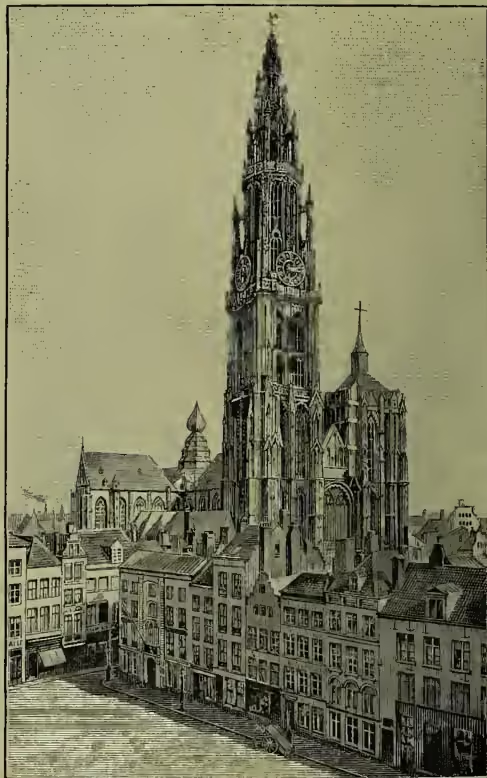
Antwerp is mentioned as early as the 8th century; in the 12th and 13th it gave signs of considerable prosperity, and in the beginning of the 16th century it was the commercial capital of the world. Its government was free, and its people prosperous and well educated. When in 1576 it was seized by the Spanish soldiery, it is estimated that 8000 human beings were murdered; and the city-hall and nearly a thousand fine buildings were burnt. The effect of this, and the assault of the Duke of Parma in 1583, caused Antwerp to sink into decay, and its population was scattered. From 1794 till 1814, while it was held by the French, Napoleon attempted to make it a great military and commercial centre. The union of Belgium with Holland in 1815 was very favourable to the commerce and general prosperity of Antwerp. By the revolution of August 1830, it was linked to the destiny of Belgium. When the revolutionary party gained possession, the Dutch commandant, General Chassé, retreated to the citadel, and, exasperated by the breach of truce, commenced a bombardment, which destroyed the arsenal and about thirty houses. In 1832 a French army of 50,000 men, under Marshal Gérard, appeared before Antwerp, to demand the surrender of the citadel, which General Chassé refused. After the interior of the citadel had been reduced to ruins by the French artillery, General Chassé capitulated. The city was handed over to the Belgians, and since the treaty of 1839, Antwerp has had a singularly prosperous career. Amongst the eminent names associated with Antwerp are the painters Matsys, Rubens, Vandyck, Teniers, Van Brée, and Jordaens, with Van Meteren, historian, and Conscience the novelist; statues have been erected to the first five of these, as also to Leopold I., Van Ryswyck, and others. French is the business language, but the majority of the inhabitants speak Flemish.