Aph'orism

Chambers's Encyclopaedia, Volume 1: A to Beaufort, p. 332–333
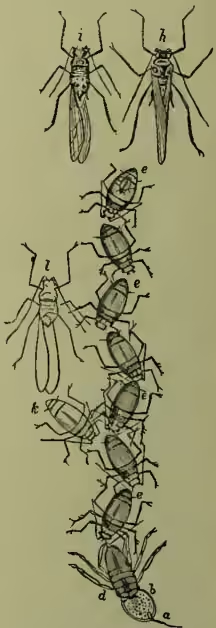
Figure 2: Owen's figure showing the life-history of Aphid. It is a vertical sequence of nine illustrations labeled 'a' through 'i'. 'a' shows a winged female. 'b' shows a wingless female. 'c' shows a winged female. 'd' shows a winged female. 'e' shows a winged female. 'f' shows a winged female. 'g' shows a winged female. 'h' shows a winged female. 'i' shows a winged female. The sequence illustrates the development from a spring form to a succession of parthenogenetic viviparous forms, and finally the reappearance of sexual individuals in autumn.
Fig. 2.—Owen's figure, showing life-history of Aphis: d , the first spring form developing from fertilised ovum; e , the succession of parthenogenetic viviparous forms; h and i , the reappearance of sexual individuals, male and female, in autumn; k and l , the appearance of sexual forms at an earlier date.

Aph'orism (Gr.), a principle expressed tersely in a few words, or a short and pithy sentence conveying a general truth; such as, 'Use is second nature.' A whole work is sometimes written in the form of a series of aphorisms, arranged in due order, and leaving their connection to be traced by the reader's reflection. Occasionally impressive, this style is more often wearisome. The name was first used in the Aphorisms of Hippocrates.

Source scan(s): p. 0351, p. 0352