Apollo (Gr. Apollōn) may be regarded as the characteristic divinity of the Greeks, inasmuch as he was the impersonation of Greek life in its most beautiful form, and the ideal representative of the Greek nation. His mild worship, with its many festivals, accompanied as they were by a cessation from all hostilities; his various shrines at sacred places, with their oracles; and the general idea of his character, had a wide, powerful, and beneficent influence on social and political life throughout the states of Greece. Homer and Hesiod mention that he was the son of Zeus and Leto, and twin-brother of Artemis, but neither states where he was born. The Ephesians believed that he was born in a grove near their city. The most popular legend was that which made him a native of Delos, one of the Cyclades, where his mother Leto, followed by the jealous wrath of Hera over land and sea, at length found rest and shelter, and was delivered of him, under the shadow of a palm or olive tree, at the foot of Mount Cynthus. To spite Hera, who was far from being a favourite with the other goddesses, these hastened to tender their services to the weak and wearied Leto. Themis fed the young Apollo with nectar and ambrosia, the food of the gods, which seems to have suddenly excited the self-consciousness of the infant deity, as he surprised his nurse by starting to his feet, demanding a lyre, and announcing his intention of henceforth revealing to mortals the will of Zeus. The island, proud of having been the birthplace of the god, adorned itself with a robe of golden flowers.
In ancient literature Apollo is described as possessed of many and various powers, all of which, however, appear to be intimately related to each other. He is spoken of: (1) As the god of retributive justice, who, armed with bow and arrows, sends down his glittering shafts upon insolent offenders. In this character he appears in the opening of the Iliad. (2) As the instructor of bards, and the god of song and minstrelsy, playing upon the phorminx or seven-stringed lyre, and singing for the diversion of the other deities when engaged in feasting. (3) As the god of prophetic inspiration, especially in his oracle at Delphi. (4) As the guardian deity of herds and flocks, as in his care of the flocks of King Admetus at Pheræ in Thessaly. (5) As the god of medicine, who affords help, and wards off evil. In this sense he is represented as the father of Asclepius (Æsculapius), the god of the healing art. (6) As a founder of cities, and the spiritual leader of colonists. According to Homer, he assisted in building the walls of Troy. Cyrene, Naxos in Sicily, and other cities, venerated him as their founder. By the later writers he was identified with Helios, the sun-god, though Homer describes the latter as a distinct deity. Several critics, however, have regarded Helios, or the sun-god, as the true original Apollo—an opinion supported by many probabilities. In the Greek mythology, Apollo forms with the supreme Zeus and Athene a kind of divine triad. He is the beloved son of Zeus, the revealer of his counsel, one in mind and will with him.
The predominance of his worship, carried with them by the wide-spreading Greek colonies, who were under his peculiar care, marks a higher stage in the development of Greek religion, by which a limit was put to the polytheistic idea, and the ethical took the place of the merely physical. Apollo could only be approached with a pure heart, and self-examination was the first condition of his discipleship. It was from the Lycians that his worship came to Greece, and it was by them first that the lofty ideal of the humanisation of deity was conceived. His worship touched the glowing imagination of the Greek, and thus in Apollo, the saviour and purifier, the guide to self-control without self-mortification, Greek religion may be said to have reached the climax of its development. His oracle at Delphi inculcated a really high standard of religious life for three hundred years, and it was not till about the end of the 6th century B.C. that it began to decline. It is significant that it was the Apollo worship that won the heartiest homage of Socrates. It was to the Greek art and philosophy that it owed its development into the ideal of humanity, and it ever constituted the brightest side of the Greek mind. The most celebrated oracles of Apollo were at Delphi, Abæ in Phocis, Ismenion in Thebes, Delos, Claros near Colophon, and Patara in Lycia. One of the most common epithets for Apollo is Phæbus ('the bright' or 'pure'), which occurs in Homer, and later was applied to Apollo more particularly as the sun-god. Another was Smintheus, most probably from sminthos, 'a mouse,' there being a statue of the god at Chryse with a mouse under its foot, while on coins he frequently carries a mouse in his hands (see Lang's Custom and Myth). Among the Romans, the worship of Apollo was practised as early as 430 B.C., and prevailed especially under the emperors. But there can be no doubt that the Romans derived their conceptions of Apollo entirely from the Greeks. It was in honour of him and his sister Diana (Artemis) that the ludi sæculares were celebrated every hundred years. The attributes of Apollo are the bow and quiver, the cithara and plectrum, the snake, raven, shepherd's crook, tripod, and laurel; less frequently, the grasshopper, cock, hawk, wolf, and olive-tree.
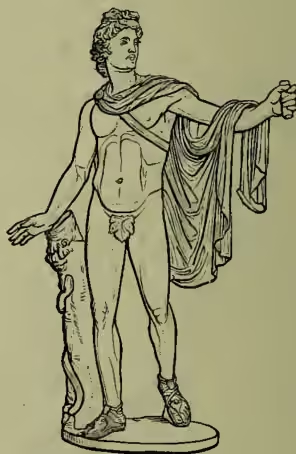
In sculpture, he is generally represented with a face beautifully oval, high forehead, flowing hair, and slender figure. The most famous representation of the god is the Apollo Belvedere at Rome, a figure in which are combined the highest intellect with the most consummate physical beauty. It is supposed to be a copy of a bronze votive statue erected at Delphi, and representing the god repelling the Gauls (279 B.C.) from his shrine. From another copy, a bronze statuette at St Petersburg, known as the Stroganof Apollo, it is found to have been an ægis, not a bow, that the figure held in the left hand. The statue (upwards of 7 feet high) is naked, but a cloak fastened round the neck hangs gracefully over the extended left arm; the expression of the face is one of calm and godlike triumph, mixed with 'beautiful disdain.'
This great work of art was discovered in 1495 amid the ruins of ancient Antium, and purchased by Pope Julius II., who placed it in the Belvedere of the Vatican, whence the name it bears. The left hand and the right fore-arm, wanting in the statue as discovered, were restored by a pupil of Michael Angelo.