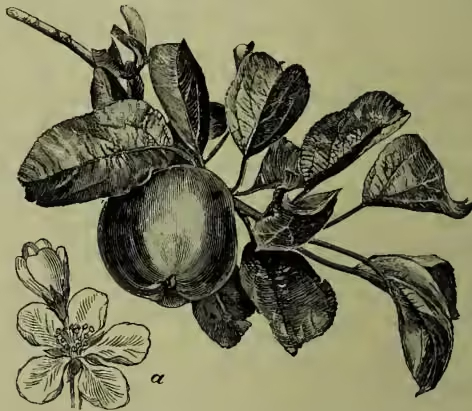
a, piece of the blossom.
Apple (Pyrus malus). For the generic character, see PYRUS). This well-known fruit has been very long cultivated, and by that means it has been very much improved. It was extensively cultivated by the Romans, by whom, probably, it was introduced into Britain. The wild apple, or Crab-tree, a native of Britain, and very generally found in temperate climates of the northern hemisphere, is a rather small and often somewhat stunted-looking tree, with austere, uneatable fruit; yet it is the parent of all, or almost all the varieties of apple so much prized for the dessert. The apple-tree, even in a cultivated state, is seldom more than 30-40 feet high. It has a large round head; the leaves are broadly ovate, much longer than the petioles, woolly beneath, acute, crenate, and provided with glands; its flowers are always produced in sessile umbels, and are various in size, according to the variety. Some are almost as white as pear-bloom, but the great majority are either striped or tinged with rosy tints outside, and some are of bright carmine. All have a delicate fragrance, much more refined than that of pear-bloom. The fruit is roundish, or narrowest towards the apex, with a depression at each end, generally green, but also frequently yellow, light red, dark red, streaked, sometimes even almost black, with the rind sometimes downy, sometimes glabrous, sometimes thickish, and sometimes very thin and transparent, varying in size from that of a walnut to that of a small child's head—the taste more or less aromatic, sweet, or subacid. It is produced on spurs which spring from branchlets of two or more years' growth, and continue to bear for a series of years. The fruit of the apple is, with regard to its structure, styled by botanists a Pome (q.v.). The eatable part is what is botanically termed the mesocarp (see FRUIT), which, in its first development, enlarges with the calyx, the summit of the fruit being crowned in general by the dried quinquefid sepals; the endocarp being, when ripe, cartilaginous, and containing in its cells seeds which do not correspond with them in size, but are so free as sometimes to rattle when it is shaken. Dr Hogg has introduced a more scientific classification of varieties, according to the structure of the stamens, the tube, the carpels, and the sepals.
The apple is now one of the most widely diffused of fruit-trees, and for the general fruit-supply of Britain is the most valuable of all. It succeeds best in the colder parts of the temperate zone. It is, however, to be met with on the coasts of the Mediterranean Sea, in Arabia, Persia, the West Indies, &c., but there its fruit is as small and worthless as in high northern latitudes. The varieties in cultivation are by far too numerous. They have been classified with great care by German, French, English, and American writers, by whom the classification and description of apples, pears, and similar fruits has been made quite a matter of science, and entitled Pomology. Metzger, in his description of the pomaceous fruits of Southern Germany, describes 89 different kinds of apple, all of which are constant, besides sub-varieties. There are now at least 2000 varieties cultivated in Great Britain, and perhaps twice that number, for many provincial sorts have as yet escaped the pomologist. New varieties are continually produced from seed; and as the apple is chiefly propagated by grafting—although some few can also be raised by means of layers and cuttings—the older varieties are superseded in many cases by newer ones. But some of the best kinds still in use can be traced back for centuries. The costard, from which dealers in apples received the name of costardmongers, still exists, though not largely grown, perhaps on account of the ribbed formation, from which it is believed to take its name, pomum costatum. Certain family divisions have been made, popular rather than correct, of apples (as of pears and plums)—e.g. Pippins, Codlins, Russets, Rennets, Pearmains, Calvilles, Crabs, &c. Some kinds, not approved for the dessert, are in high esteem as baking-apples, and others still more acid or austere are preferred for the manufacture of Cider (q.v.).
The apple is grown in Britain either as a standard, an espalier, or a wall-tree, and is variously trained. It was generally grafted on apple or crab stocks, but now a dwarf variety, either the Paradise or Doucin stock, is largely used to restrict the growth and hasten the time of bearing; and trees thus dwarfed are often very productive when little larger than currant or gooseberry bushes. Some of the varieties of apple are more hardy than others, and are therefore to be preferred for cold or exposed situations. Some of the finest kinds succeed well only when the soil and climate are good. Some kinds are much earlier than others in flowering, some in ripening. It is a mistake to suppose that an early bloomer is therefore an early ripener. The converse is frequently the case with all fruit-trees.
The wood of the apple-tree is hard, durable, and fine-grained. The crab is often planted both as an ornamental tree and for the sake of its wood. The bark contains a yellow dye.—As a fruit-tree, the apple requires a fertile soil and sheltered situation. The various uses of the fruit—for the dessert, for baking, preserving, making jelly, &c., as well as for making the fermented liquor called cider—are sufficiently well known. Vinegar is also made from it; and sometimes a kind of spirit, especially in Switzerland and Swabia. It contains Malic Acid, which is extracted for medicinal purposes.—The fermented juice of the crab apple is called Verjuice. It is used in cookery, and sometimes medicinally; also for the purifying of wax. Apples are an important article of commerce. Great quantities are imported into Britain, chiefly from France, Canada, and the northern parts of the United States. The apple keeps better than most kinds of fruit. Beaufins or Biffins are apples slowly dried in bakers' ovens, and occasionally pressed till they become soft and flat. They are prepared in great quantities in Norfolk.
The SIBERIAN CRAB is perhaps the parent, by hybridisation or otherwise, of some of the varieties of apple now in cultivation. Two species partake this designation, both natives of Siberia, and frequent in gardens in Britain—Pyrus baccata of Linnaeus, and Pyrus prunifolia of Willdenow, which, however, scarcely differ, except that in the former the sepals (leaves of the calyx) are deciduous, in the latter they are persistent—a circumstance of very doubtful importance as a specific distinction. The fruit is sub-globose, yellowish, and rather austere, but is good for baking and for preserves.
The AMERICAN CRAB or SWEET-SCENTED CRAB (P. coronaria) is a native of North America, especially of the southern part of the Alleghanies. It is a small tree with broad leaves and white flowers, becoming purple before they drop off, and which have a powerful smell, resembling that of violets. The fruit is flatly globose, of a deep green colour, and sweet scented. It is very acid, but is made into cider, and also into preserves. P. angustifolia, a native of Carolina, much resembles this, but has much narrower leaves, and smaller fruit.
The CHINESE CRAB (P. spectabilis) is a small tree, a native of China. It is very ornamental when in flower; the flowers being in sessile, many-flowered umbels, and of a bright rose-colour. The fruit is irregularly round, about the size of a cherry, yellow, and fit to be eaten, like the medlar, only when in a state of incipient decay. See the Report of the National Apple Congress (1884); The Herefordshire Pomona, edited by R. Hogg and H. G. Bull, 2 vols. folio (Hereford, 1876-85).