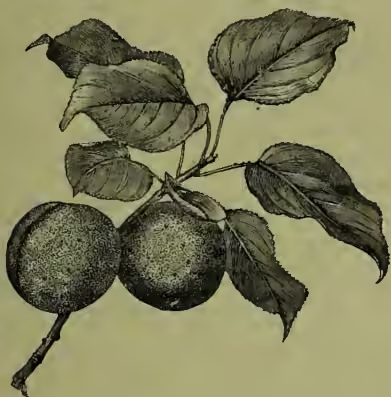
Apricot (Prunus armeniaca), a species of the same genus with the Plum (q.v.), is a native of Armenia, and of the countries eastward to China and Japan; a middle-sized tree of 15–20, or even 30 feet high, with ovate, acuminate, and cordate, smooth, doubly-toothed leaves on long stalks; solitary, sessile, white flowers which appear before the leaves, and fruit resembling the peach, roundish, downy, yellow, and ruddy on the side next the sun, with yellow flesh. The apricot was brought into Europe in the time of Alexander the Great, and since the days of the Romans has been diffused over all its western countries. It has been cultivated in England since the middle of the 16th century. It is only in the south of England that it is ever trained as a standard, nor is it grown in the more northern parts even as an espalier, but almost always as a wall-tree. More than twenty kinds are distinguished, amongst which some excel very much in size, fine colour, sweetness, and abundance of juice. The Moorpark is generally esteemed the finest variety, and the Breda as best suited for standards in the south of England, and in Scotland even for the wall, except in the most favourable situations.—The apricot is generally budded on plum or wild cherry stocks. The fruit keeps only for a very short time, and is either eaten fresh, or made into a preserve or jelly. Apricots split up, having the stone taken out, and dried, are brought from Italy as an article of commerce, in particular from Trieste, Genoa, and Leghorn: in the south of France, also, they are an article of export in a preserved and candied state. Dried apricots from Bokhara are sold in the towns of Russia, the kernels of which are perfectly sweet, like those of the sweet almond. The kernels are sweet in some kinds, and bitter in others—the bitterness being probably more natural, and the sweetness, as in the almond, the result of cultivation. Generally speaking, they may be used for the same purposes as almonds. From the bitter kernels, which contain Prussic acid, the Eau de noyan is distilled in France. The charred stones yield a black pigment similar to Indian ink. The wood of the tree is good only for the purposes of the turner.
The Briançon Apricot (P. brigantiaea) very much resembles the common apricot. The fruit is glabrous. It is found in Dauphiné and Piedmont. At Briançon, an oil, called Huile de marmotte, is expressed from the seeds. The Siberian Apricot (P. sibirica) is also very like the common apricot, but smaller in all its parts. The fruit is small. It is a native of Siberia, especially of the southern slopes of the mountains of Dahuria. The Apricot Plum is, as the name implies, not an apricot. It is an excellent kind of plum, which, in some parts of France, is preserved in sugar, dried, and extensively exported.
The older form of the name, aprieock, best shows the descent of the word through Portuguese albricoque, Arab. al (the) barqūq, and late Gr. praikokion, from Lat. præoqua, præox, 'early ripe.'