Apteryx (Gr. a, 'without,' pteryx, 'wing'), or KIWI, a genus of New Zealand birds, belonging to the sub-class Ratitæ, in which the breastbone has no keel. It is thus allied to the ostrich-like birds.
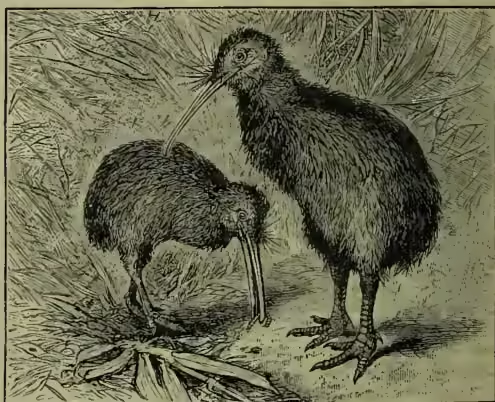
It is usually about the size of a large hen, but some measure two feet or more in height. The colour is reddish-brown or gray. Though incapable of flight, it is not really wingless; the rudimentary stump, with short humerus and one complete digit, is merely hidden by the downy feathers which thickly cover the body. The barbs of the feathers are not united, and there is no aftershaft (see FEATHER). The short, scale-covered legs are strong, and enable the bird to avoid its enemies by rapid running. The three anterior toes are armed with strong claws, used in scratching and as weapons, while the posterior fourth toe is short and raised from the ground. The long, slender, rounded beak, with the nostrils at its tip, is largely used for pulling worms out of the ground. The bones of the body do not exhibit the usual air-cavities found in flying birds. The apteryx lies during the day in holes in the ground, or at the foot of trees, and comes out in the twilight. They feed on worms, grubs, and also 'hinau berries.' They make a peculiar snuffling noise when hunting or feeding. They live in pairs, and the female lays, apparently twice a year, a very large egg, which is deposited in a hole at the foot of a tree or tree-fern. The male takes some share at least in the labour of incubation. Four species have been distinguished, two of which belong to the North Island, and two to the South Island of New Zealand. It is, however, somewhat uncertain whether the four forms are really distinct.