Aquatic Plants. The presence of water is not only essential to the active life of all organisms, but is peculiarly necessary for plants which are for the most part dependent for food-supply on matter dissolved in water, as well as on the carbonic anhydride mingled with the surrounding medium. Numerous plants are, moreover, in the strict sense of the word aquatic, having never acquired or having lost all direct connection with the soil. The simplest plants or Algae are almost all aquatic, though many occur in damp situations on land, or on other organisms, while others remain for long periods quiescent in comparative dryness. Many Algae are absolutely isolated in the water, while others are more or less intimately fixed to some solid substratum. Fungi are very seldom found in water, and lichens are also emphatically terrestrial. Some Liverworts, again, occur floating in lakes, but the majority grow in very damp places, and mark the transition to the generally terrestrial life of mosses and ferns. Some Rhizocarps, such as Salvinia, are aquatic, with leaves rising to the surface, while others are land or marsh plants, like the higher horse-tails and club-mosses.
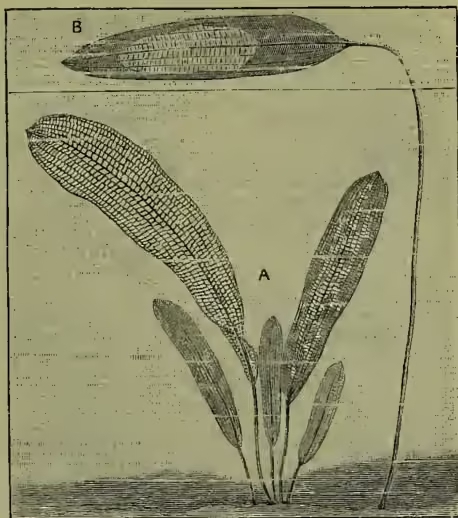
Among the flowering plants or phanerogams, a return to aquatic life is exhibited by numerous, though exceptional cases, while a very large number grow in moist situations, and have a semi-aquatic habit. The simple Monocotyledons known as Helobia (q.v.) or marsh-ilies are more or less strictly water-plants. The Arrow-head, q.v. (Sagittaria), and other Alismaceæ; the Butomus of the marshes; Hydrocharis, with floating kidney-shaped leaves; the water-soldier (Stratiotes), with narrow submerged leaves; and the Canadian pond-weed (Anahearis, q.v.), which, though entirely flowerless in Europe, threatens to choke some canals and lakes, are familiar representatives. The little duck-weed (Lemna) floating on the surface of stagnant pools is one of the commonest aquatic Monocotyledons; and the pond-weeds (Potameæ) found both in fresh and salt water; the lattice-plant (Ouvirandra, see fig. 1), with its skeleton leaves; various estuarine and fresh-water Naiadaceous plants—e.g. Zostera and Naias, are also common instances, while those growing in marshy ground are much too numerous to mention. Among Dicotyledons, the white water buttercup (Ranunculus aquaticus), with its slightly divided floating, and much dissected submerged leaves; the yellow and white water-ilies (Nymphaæ); the sacred lotus-flower of the Ganges and Nile (Nelumbium); the gigantic Victoria regia of tropical South America; and the insectivorous bladderwort or Utricularia, are among the most familiar aquatic forms.
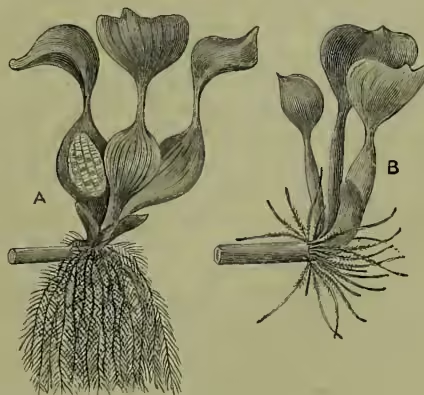
Numerous modifications have naturally resulted in adaptation to aquatic life. The roots growing out in a relatively frictionless medium may become, as in Hydrocharis and Pontederia (see ROOT), long and delicate, covered with numerous and uniform root-hairs, which thus expose a large absorbing surface. In Utricularia, on the other hand, where the whole plant is submerged with the exception of the flower-stalk, root-structures are not developed at all. The leaf-stalks of a Pontederia growing in the water, show, when contrasted with those of another growing on land, an enormous development of air-spaces, which serve to buoy up the floating plant. Submersion seems to increase the surface of leaves at the expense of their thickness, and this in Monocotyledons usually results in elongation in one direction (Sagittaria, Vallisneria, &c.), and in Dicotyledons, in the development of numerous capillary divisions, as in Ranunculus aquaticus and Myriophyllum. The change may sometimes be experimentally demonstrated by artificial change of environment, while the foliage of Sagittaria, Alisma, Nuphar, &c. is very different, according as the leaves are submerged, floating, or aerial. In aquatic plants, the Stomata (q.v.) are usually absent or scarce on the lower surface of the floating leaves, and on both sides of the submerged; and many more intimate changes, such as the disappearance of hairs, the occurrence of chlorophyll in the epidermis, and so on, have been repeatedly observed to follow change to an aquatic medium. Some plants, such as Zostera, even flower under water, but an exposure and relative drying at the surface has been shown to be in some cases essential to the germination of the seeds. The fruits of the water-lily keep afloat by means of large air-spaces, and those of the arrow-head are protected by a thick oily rind. The whole subject of the adaptive modifications of aquatic plants is obviously a special case of the general problem of the relation between organism and environment, and for further details reference must be made to the separate articles on some of the plants cited as instances, and to ENVIRONMENT.