Aqueduct. This term is perhaps most commonly understood to mean a bridge of stone, iron, or wood, for conveying water across a valley. But a pipe, an open channel, or a tunnel through a mountain is equally an aqueduct, if its function is to convey water from one place to another. All great aqueducts have been constructed for the purpose of conducting water from some more or less distant source to large towns or cities. The term is also properly applied to a bridge carrying a canal for the purposes of navigation.
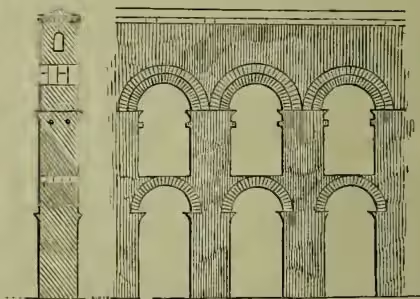
Roman Aqueducts.—The aqueducts of the Romans were amongst the most magnificent of their works, and the noble supply of water which modern Rome derives from the four now in use, of which three are ancient, gives the stranger a very vivid conception of the vast scale on which the ancient city must have been provided with one of the most important appliances of civilisation and refinement, when nine were employed to pour water into its baths and fountains. The bridge portions of an ancient Roman aqueduct consist most frequently of one row of arches, but sometimes, as in the annexed figure (fig. 1), of two, and occasionally, when the height is great, even of three tiers. Some of these were built of hewn stone and others of brick, but in nearly every case they were very substantially constructed. Several of them, indeed, after the lapse of two thousand years, have been put in repair and used again as modern aqueducts. The water-channel in one or two of the larger ones is about 5½ feet high and 4 feet wide. This was, of course, formed in the upper part of the structure, above the arches, and was covered on top, bottom, and sides with a lining composed of lime, sand, and pulverised brick, which in time acquired the hardness of stone. The declivity of these ancient aqueducts was generally about 1 in 200, a much greater slope than is given to modern works of a similar kind. Reservoirs (castella) were built at regular intervals along the aqueducts to enable repairs to be made, and to supply water, where necessary, to the inhabitants of the outlying districts.
Of the nine aqueducts which brought water to ancient Rome, three still supply the modern city. (1) The Aqua Virgo, now called Acqua Vergine, which was restored by Pope Nicholas V. in 1453. This name is said to have originated from a young girl having pointed out the spring at its source to some soldiers. The aqueduct was made by Agrippa, and finished about the year 27 B.C. It mainly consists of a subterranean channel 14 miles in length, and supplies daily about 13,000,000 cubic feet of excellent water. (2) The Aqua Trajana, restored by order of Paul V. in 1611, hence its modern name of Acqua Paola. It stretches from Rome to the lake of Bracciano, a distance of 31 miles. (3) The Aqua Marcia, constructed by the prator Q. Marcus Rex in 146 B.C. This is 56 miles in length, and is very little shorter than the longest of the ancient aqueducts at Rome. It was restored so recently as 1869, and brings a supply of water from the Sabine Mountains. The noble arches which stretch across the Campagna for some 6 miles on the road to Frascati are a portion of this aqueduct. Besides these three repaired ancient aqueducts, a fourth of comparatively recent date supplies modern Rome. This is the Acqua Felice, completed by Sixtus V. in 1585, and largely built of material taken from the arches—about 10 miles in length—of the ancient Aqua Claudia. The length of the Acqua Felice is some 13 miles, and two-thirds of it is subterranean.
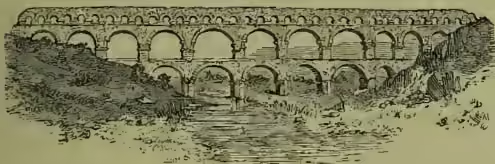
Provincial Roman Aqueducts.—Away from the capital there are a number of ancient Roman aqueducts in Italy itself. The ruins of one exist at Mayence, and of another near Metz, in Germany. France possesses, in the Pont du Gard at Nîmes (fig. 2), erected in the time of Augustus, one of the finest and most perfect of the aqueduct-bridges built by the Romans. It is higher than any about Rome itself, being fully 180 feet in height, and the length of its highest arcade is 873 feet. Spain has also interesting Roman works of this kind at Segovia, at Tarragona, and at Merida. The one at Evora, in Portugal, is still in excellent preservation.
Spoletto Aqueduct.—As forming a link between the ancient Roman structures and the great aqueduct-bridges of modern times, that of Spoletto, about 60 miles to the north-east of Rome, should be mentioned. Erected in the 6th or 7th century, it serves both as a bridge and as an aqueduct, and is a wonderful piece of engineering for its time. The very tall piers are built of a durable stone, and the pointed arches are of brick. It is about 300 feet high, nearly 700 feet long, and the ten great arches have each a span of 66 feet. These are surmounted by a row of much smaller arches carrying the canal of the aqueduct. There exists some doubt as to whether the arches of this very interesting bridge are not of considerably later date than the piers.
Maintenon Aqueduct.—Many centuries elapsed before another aqueduct of special interest or importance was undertaken in Europe. In 1684 Louis XIV. set his engineers to construct an aqueduct to convey the waters of the Eure from Point Gouin to Versailles. Troops to the number of 40,000 were employed in this great undertaking. Thousands of these men died during the progress of the work, which was interrupted during the war of 1688 and never resumed. The bridge at Maintenon, forming part of this aqueduct, even in its incomplete state, is, in point of magnitude, the grandest structure of the kind in the world. The remains consist of forty-seven arches, each 42 feet wide and 83 feet high. The piers are 25 feet 6 inches thick.
Marseilles Aqueduct.—The aqueduct, 60 miles in length, which conveys water from the river Durance to Marseilles, is another magnificent specimen of French engineering. It was finished in 1847.
Croton Aqueducts.—New York is supplied with water from the Croton River, which falls into the Hudson. The aqueduct at present in use was constructed between the years 1837 and 1842. It is 38 miles long, with a declivity for the greater part of its course of inches to the mile. For a length of 33 miles the water-channel is 8 feet 5 inches in height, and 7 feet 8 inches in greatest breadth. Stone, brick, and cement are used for the encasing masonry, which varies slightly as the channel is formed in rock, or earth, or in an open cutting. In flat valleys the built conduit has sloping earth embankments on each side. When it reaches the Harlem River the water is conveyed in iron pipes over a splendid bridge. These large pipes also connect the receiving and the distributing reservoirs, which are two miles apart.
This first Croton aqueduct, though justly considered one of the grandest modern works of its kind, has been found to be totally inadequate for New York. Accordingly a new aqueduct on a more stupendous scale was constructed in 1883-90, with a dam of vast size (1350 feet long, 277 high, 216 wide). For more than 28 miles the conduit or water-channel is tunnelled through solid rock, at a depth of 150 feet below the surface, and is generally 14 feet high and wide. It passes under the Harlem River at a depth of 300 feet below the river-bed, and cost $25,000,000 (see NEW YORK, Vol. VII. pp. 484, 485; and WATER). The port of Mollendo in Peru has an iron aqueduct of 85 miles laid along the railway from Arequipa.
Manchester Aqueducts.—Very large works were constructed during nine years, ending in 1877, to bring water from Longdendale, between Sheffield and Manchester, to the latter city. In this instance the aqueducts consist for the most part of tunnel and covered conduit, but for 8 miles the water is conveyed in large cast-iron pipes laid along or under the public roads. Before the Longdendale works were finished, the question of a greater supply had to be considered. This led to the adoption of the scheme for bringing water from Lake Thirlmere in Cumberland to Manchester. The length of the line is nearly 100 miles, and the works were carried out in 1885-94. A tunnel, about three miles in length and 270 feet below the surface, forms the first part of the aqueduct. The distance is close on 100 miles ( to Prestwich reservoir)— in tunnels, 38 in shallow tunnels cut from the surface, and miles in siphon pipes of 40 inches diameter. The aqueduct passes under Dunmail Raise, north of Grasmere, Ambleside, Windermere, and Keudal, to the east of Lancaster and Preston, across the rivers Lune and Ribble, past Chorley, and west of Bolton. The ultimate supply is 50,000,000 gallons daily, and the cost £4,500,000.
Loch Katrine Aqueduct.—The first aqueduct from Loch Katrine to Glasgow was begun in 1855, and completed in 1860, and is about 35 miles long. The tunnelled portion is 13 miles in length, and is 8 feet high and 8 feet wide, with an inclination of 10 inches in a mile. Siphon pipes of cast-iron are laid across the valleys, having an inclination of 5 feet in a mile. The ravines are crossed by aqueduct-bridges of varying character. Where they are deep they are crossed by wrought-iron tubes, 8 feet wide by feet high, supported by stone piers 50 feet apart. Over small mountain-streams the aqueduct consists of cast-iron troughs, supported on beams of the same material. In those portions of its course where suitable rock is abundant, some of the bridges are of freestone. There is one tunnel at the commencement of the aqueduct, near Loch Katrine, 2325 yards long, and at the other end, near Glasgow, the Mugdock tunnel is 2640 yards in length. A great additional supply from the same source, increasing the daily provision from 50,000,000 to 100,000,000 gallons daily, was secured by new works completed in 1889-95, which constitute practically a complete duplicate of the former ones (with a distinct reservoir, &c.). The cost of both systems has been about £3,000,000.
Liverpool Aqueduct.—Another aqueduct of great magnitude was constructed in 1881-92 for the supply of water to Liverpool from the river Vyrnwy (q.v.) in Wales. Its total length is 68 miles. It consists partly of tunnel and partly of three parallel lines of iron pipes. The first (Hirnant) of the three chief tunnels is miles long, 7 feet in diameter, and has a gradient of 1 in 2340. The cost was about £2,500,000.
Vienna Aqueduct.—This aqueduct is nearly 60 miles long, and was finished in 1873. The springs are at the foot of the Styrian Alps, and are about 1150 feet above the level of the Danube at Vienna. The size of the section of the conduit or waterway varies, but it nowhere exceeds 6 feet 6 inches in height, by 4 feet in width. At several places in its course there are extensive aqueduct-bridges, and these are built either entirely of stone, or of stone and brick; one has forty-three arches. This aqueduct supplies 20 million gallons of water per day. It cost about two million pounds sterling.
Bombay Aqueduct.—A gigantic scheme for the supply of Bombay from the river Tausa (q.v.), 65 miles N. of Bombay, was completed in 1886-92. The aqueduct consists mainly of two lines of cast-iron pipes, 48 inches in diameter, which here are allowed, for the most part, to lie on the surface of the ground. There no frost can injure them, and any leakage can be at once seen.
Canal Aqueducts.—Of aqueduct-bridges for carrying navigable canals across rivers or valleys, the finest in Great Britain is that built by Telford over the Dee in Wales. Another fine bridge of this kind, designed by Rennie, crosses the river Lune. In Scotland there is one at Slateford, near Edinburgh, and another over the Kelvin at Glasgow.