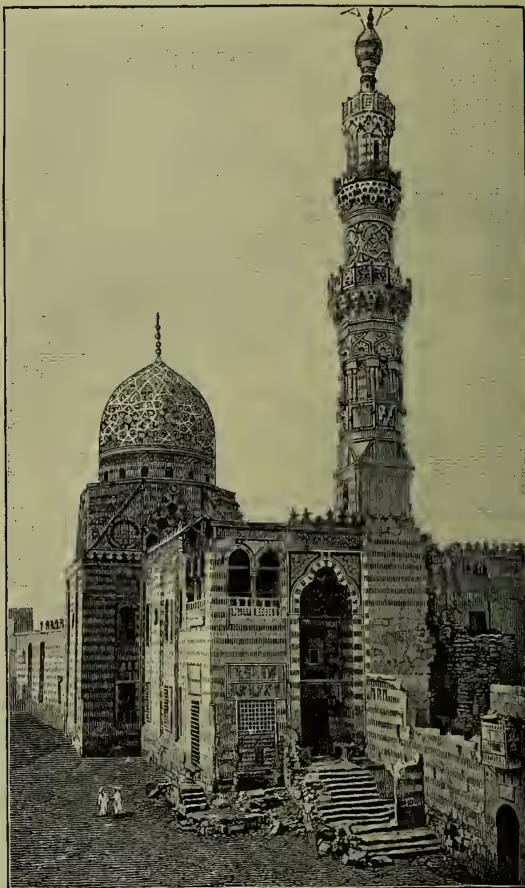
(From a Photograph by Frith.)
Arabian Architecture. Before the time of Mohammed, and for long after, the Arabs or Moslems had no special architecture. They were not a temple-building people, but from their intercourse with the western nations they acquired a desire to give their religion a visible embodiment, like the churches of the Christians. Having no architects of their own, they had to engage architects and workmen from Byzantium; and their earliest mosques were thus erected in the style of the late empire, but of course the dispositions of the buildings were adjusted to suit the requirements of their worship. By degrees, the court usually placed in front of the Christian church became enlarged and surrounded with arcades, while the church was diminished in size and importance, and was represented merely by a deeper arcade. Such are the early mosques of Cairo, erected during the first two centuries of the Hedjrah, between 622 and 900 A.D. It is noticeable that in these buildings the arches are all of the pointed form, which seems to have been of very ancient use in the East. This was afterwards modified into the horseshoe shape which is peculiarly characteristic of Saracenic art. Gradually a new and fanciful ornamentation known as Arabesque (q.v.) was added to the recognised features of Greek and Roman edifices. The exclusion of animal figures, which their abhorrence of the very appearance of idolatry necessitated, confined the Mohammedan artists to the imitation of vegetable productions, varied by geometrical patterns and inscriptions, of which the letters were woven into forms which suited them for architectural uses. At first Saracenic art partook largely of the styles of the countries into which the Mohammedan religion was introduced, but gradually a style more or less homogeneous was evolved, of which fine examples are found in Persia, India, Africa, and Spain, and of which the influence continues to the present day. In India, this style finds expression in the magnificent tombs of the Tartar rulers, with their wonderful domes and graceful minarets (see AGRA). The gateways are also features of great size, on which much ornament is usually displayed. In Spain, the Moors erected many important buildings, from the mosque of Cordova, begun by Abd-el-Rahman in 786, which resembles those of Cairo in general idea, to the Alhambra at Granada, erected in the 14th century during the decadence of the Moorish rule. Many of these structures, although beautiful and elaborate in design, are unfortunately built with brick and stucco, and have yielded to the influence of time. The style of the Moors, after their expulsion from Spain, long continued to influence that of the Christians, especially in the southern part of that country.