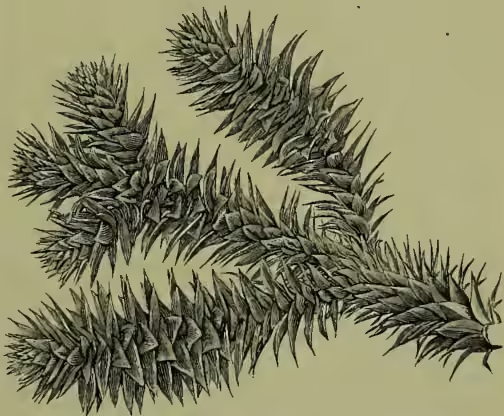
Araucária, an evergreen genus of Coniferae, consisting of lofty trees, natives of South America and Australasia. A. imbricata, sometimes called the CHILI PINE, or more popularly, from the sharp-pointed leaves, the Monkey-puzzle, is a native of the Andes of Chili, forming forests on their western declivities, where it attains a height of 100 to 150 feet. The trunk is quite straight and free from knots, and yields abundant resin. Like many pines, the young trees have branches almost from the ground, but the older ones have tall naked stems with a crown of branches. The timber is heavy, solid, hard, fibrous, yellowish white, and beautifully veined. It is very suitable for masts of ships. The resin, which is white, has a smell like frankincense, and a not unpleasant taste. The seed is pleasant to the taste, not unlike the chestnut, and is a most important article of food to the Indians. The generic name is derived from that of a tribe, the Araucanians, who especially use it as food, raw, boiled, or roasted. A spirituous liquor is also distilled from it. A single cone sometimes contains between two and three hundred seeds, and one tree may be seen loaded with twenty or thirty of these. This araucaria was introduced into Britain in the end of last century, and is now frequently planted, especially in small villa gardens, but for which its stiffly symmetrical and unvaried form is, however, peculiarly unsuitable. It is the only species which can at all withstand the climate of Britain. It requires a well-drained soil, and is apt to suffer in severe winters. A. brasiliana, the Brazil pine, has a looser and more spreading habit than A. imbricata. The seeds are sold as an article of food in Rio Janeiro, and the resin which exudes from the tree is mixed with wax to make candles. A. excelsa, the Norfolk Island pine, attains a height of 160 to 220 feet, free from branches to 80 to 100 feet, and with a trunk sometimes 11 feet in diameter. The wood is white, tough, close-grained, and so heavy as almost to sink in water. A. Cunninghamii, the Moreton Bay Pine, a native of New South Wales, very much resembles the last. It attains a height of 60 to 130 feet, and a diameter of 4 to 8 feet. The wood is yellowish, and is used for boat-building, house-carpentry, and the common kinds of furniture. The large seeds of A. Bidwillii are used for food by the natives at Moreton Bay.
Certain fossil Conifere found in carboniferous sandstone have received the names Arancarites, Araucarioxylon, &c., and are closely allied to the existing forms, which, in fact, represent far more nearly than do any other trees the primitive forms of the paleozoic age. Livingstone found such fossils in abundance on the Zambesi, and great trees of this type are not uncommonly discovered in the carboniferous quarries around Edinburgh.