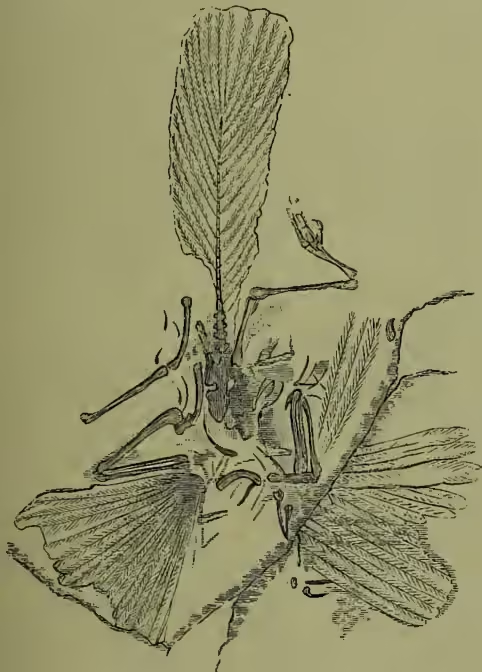
Archæop'teryx, an extinct bird, the remains of which have been obtained in the well-known Solenhofen lithographic stone—a limestone of Jurassic age—which is quarried at Aichstadt in Bavaria. Only two specimens of the archæopteryx are known—one in the British Museum, and the other at Berlin. The bird appears to have been about the size of a rook. It was at first believed to be a reptile, then a transition form between reptiles and birds, but Professor Owen showed that it was a true bird. The anomalous structure which led the first observers astray was the tail, which, instead of consisting of a few shortened vertebrae united together into a coccygean bone, as in all known birds, recent or fossil, was formed of twenty elongated vertebrae, each of which supported a pair of quill-feathers. The metacarpal bones were not anchylosed, as in all known birds, from which it also differed in having two free claws belonging to the wing. The long lizard-like tail is not so anomalous as it at first sight appears, for in the early embryonic condition of the bird, the vertebrae are distinct and separate, and the anastomosis which invariably takes place in the subsequent development of the embryo does not occur in the archæopteryx, so that it may be considered to exhibit the temporary embryonic condition of the bird as a permanent structure; and that this is the true position of this singular fossil is further established by the existence of other features which are found only in birds. These are the ornithic structure of the wings and legs, the occurrence of feathers, which are confined to birds, and the existence of a merry-thought (furculum), which is found in no other class of animals. An elevation on the surface of the slab containing the fossil is believed by many to be the cast of the interior of the skull, and it corresponds remarkably in size and form with the cast from the skull of a rook. It is probable that the jaws were furnished with teeth sunk in sockets, like the toothed birds of cretaceous times.