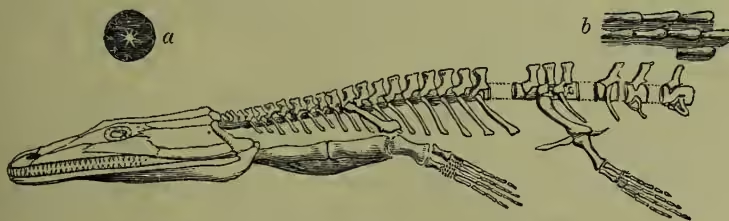
Archegosaurus, a remarkable fossil saurian reptile. It had four long, slender digits, which obviously supported a longish narrow-pointed paddle, adapted for swimming. Externally, the body was protected by a covering of oblong quadrangular scales, which are preserved in some specimens.
Several species have been described. Goldfuss considered them to be a transition state between the fish-like batrachia and the lizards and crocodiles. Professor Owen has subsequently described this fossil; he makes it a remarkable connecting link between the reptile and the fish, and on these grounds: It is related to the salamandroid-ganoid fishes by the conformity of pattern in the plates of the external cranial skeleton, and by the persistence of the chorda dorsalis, as in the sturgeon, while it is allied to the reptiles by the persistence of the chorda dorsalis and the branchial arches, and by the absence of the occipital condyle or condyles as in Lepidosiren, and by the presence of labyrinthic teeth as in Labyrinthodon, which, however, also ally it to the ganoid Lepidosteus.
There is thus in the archegosaurus a blending together of the characteristics of reptile and fish in one animal. It occupies a position between, and equally related to, the salamandroid-ganoid fishes on the one hand and the labyrinthodont reptiles on the other, while the latter conduct us through the Lepidosiren, to the perennibranchiate batrachia.