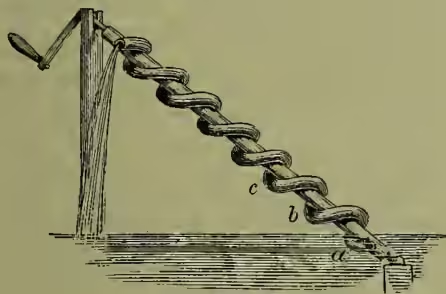
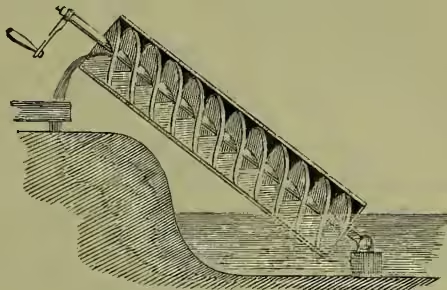
Archimedes' Screw (called also the spiral pump), a machine for raising water, said to have been invented by Archimedes, during his stay in Egypt, for draining and irrigating the land. Fig. 1 represents it in its simplest form. This consists of a flexible tube bent spirally round a solid cylinder, the ends of which are furnished with pivots, so as to admit of the whole turning round its axis. The machine is placed in an inclined position, so that the lower mouth of the tube may dip below the surface of the water to be raised. In the position represented in the figure, the lowest bend, a, of the tube will be filled with water, and if now the handle be made to turn, as seen in the diagram, in the direction of the hands of a watch, the mouth of the spiral tube will be raised above the surface; and the water inclosed in the tube, having no means of escape, will flow within it until, after one revolution, it will occupy the second bend, b. The first bend, a, has meanwhile received a second charge, which, after a second revolution, flows into the second bend, b, and takes the place of the first charge, which has now moved into the third bend, c. When, therefore, as many revolutions of the cylinder have been made as there are turns in the spiral tube, each of the lower bends will be filled with water; and in the course of another revolution, there being no higher bend for the water of the first charge to occupy, it will flow out of the tube by its upper mouth. At each succeeding revolution, the lowest bend will be charged, and the highest discharged. It will be seen from the figure that there is room to dispose a second tube side by side with the first, round the cylinder, in which case the screw would be called double-threaded. In the ordinary construction of these machines, the cylinder itself is hollowed out into a double or triple-threaded screw, and inclosed in a water-tight case, which turns round with it, the space between the threads supplying the place of such tubes as are seen in fig. 1. Fig. 2 represents a double-threaded Archimedes screw of this description, with the case removed in front. It is sometimes found convenient to fix the exterior envelope, and to make the screw work within it, the outer edge of the latter being as close as possible to the former without actual contact. This modification of the Archimedes screw receives the name of water-screw, and frequently of Dutch screw, from its being extensively used in Holland for draining low grounds.