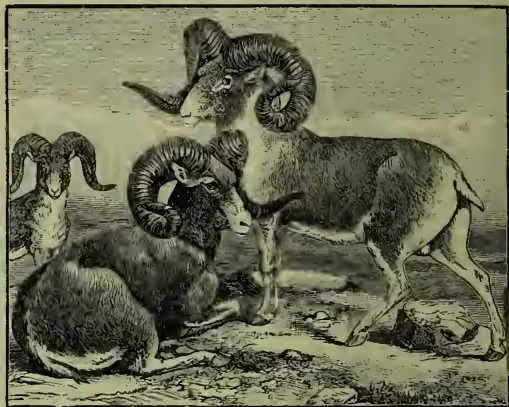
Argali (Ovis argali; also Ovis ammon), the great wild sheep of Siberia and Central Asia. It is found from Kamchatka to the Himalaya Mountains, where, however, it is only seen in the more elevated regions. 'We came suddenly,' says Dr Hooker in his Himalayan Journal, 'upon a flock of gigantic wild sheep, feeding on scanty tufts of dried sedge and grass; there were twenty-five of these enormous animals, of whose dimensions the term sheep gives no idea; they are very long-legged, stand as high as a calf, and have immense horns, so large that the fox is said to take up his abode in their hollows when detached and bleaching on the barren mountains of Tibet.' The horns of the male, which he uses for fighting, are nearly 4 feet long, and 14 inches in circumference at the base, where they are triangular. The general colour is dark gray, paler beneath, with a whitish disk around the tail. The wool is concealed by hair. The tail is a mere stump, an inch or so long. They are very keen-sighted, quick of hearing, and with a delicate sense of smell; they keep persistently to one place, and are little disturbed by the natives. They have great powers of leaping, even from heights of 20 or 30 feet. A similar but smaller form is also found on the Himalaya Mountains. The White-breasted Argali (Ovis poli) is another closely allied form inhabiting Northern Tibet. The Rocky Mountain sheep, or Big-horn (Ovis montana), which is sometimes called the American Argali, has very similar characters. See SHEEP; and for details as to Argali, Prejevalsky's Mongolia (1876).