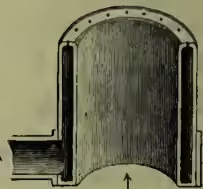
Argand, AIMÉ, physician and chemist, was born at Geneva in 1755. He was the inventor of the well-known Argand lamp. In the ordinary oil-lamp, combustion was not complete. Argand's improvement was that he made the wick in the form of a ring. The flame thus became a hollow cylinder with a current of air ascending through the inside, so that the burning surface was doubled. It would appear, however, that the lamp did not satisfy the expectations of Argand, till his younger brother accidentally discovered the effect of a glass cylinder, as a chimney over the flame, by which the flame was steadied, a draught created, and the greatest possible amount of light yielded. Argand was soon involved in a dispute with Lange, a Parisian, regarding the originality of his invention, but ultimately he consented to share the honour; and a French patent was obtained by Langé and Argand jointly. The French Revolution destroyed their privilege, and Argand lived for a time in England; he died in 1803. The same principle is employed in the Argand gas-burner. Gas is admitted by means of a side tube (A in the fig.) into the space between two concentric cylinders. This space is closed at the bottom, but the gas escapes at the top through a series of small openings. The air has free access to the outside of the flame, and also to the inside, since the internal cylinder is open above and below.