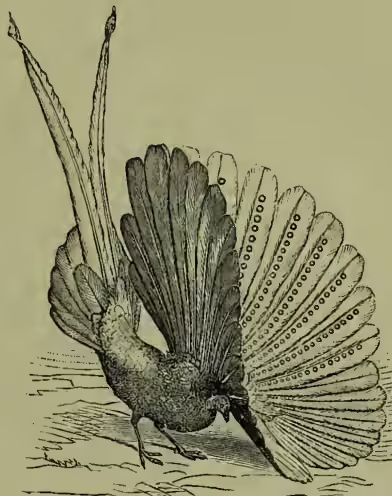
Argus, a genus of gallinaceous birds, remarkable for magnificence of plumage. The only known species is Argus giganteus, formerly called Phasianus Argus, and still very generally the argus pheasant. The bill is nearly as long as the head; the sides of the head and of the neck are almost destitute of feathers; the tail consists of twelve feathers, of which the two middle ones in the male are very much elongated, and the secondary feathers of the wings are much longer than the primary. The name argus has allusion to the many beautiful eye-like markings which adorn the plumage of the male, and particularly the secondary wing-feathers. The primary feathers are also exquisitely marked. The ornaments are hidden except when the male shows himself off to his mate. 'He then erects his tail, and expands his wing-feathers into a great, almost upright circular fan or shield, which is carried in front of the body. The neck and head are held on one side, so that they are concealed by the fan; but the bird, in order to see the female before whom he is displaying himself, sometimes pushes his head between two of the long wing-feathers, and then presents a grotesque appearance.' The marvellous decoration, according to Darwin, serves solely as a sexual charm, and the development of the ball-and-socket or eye-like markings, which he has shown to be connected by a perfect series of gradations with the simple spots, affords beautiful illustration of variation associated with Sexual Selection (q.v.). The decorative development seems really to have gone too far, for the size of the secondary wing-feathers is said almost to deprive the male bird of the power of flight. The female is of comparatively tame plumage, not only wanting the eye-like markings, but also the great length of the secondaries and of the middle tail-feathers. The size of the bird, when divested of its plumage, is not much greater than that of a common barn-door fowl; but the total length of the male, including tail-feathers, is over 5 feet, and the secondaries alone may be almost 3 feet long. The argus is a native of Sumatra and other eastern islands, of the peninsula of Malacca, Siam, &c. It is said to be found even in the northern parts of China. It is impatient of confinement, and has very seldom been brought alive to Europe. See Darwin, Descent of Man.