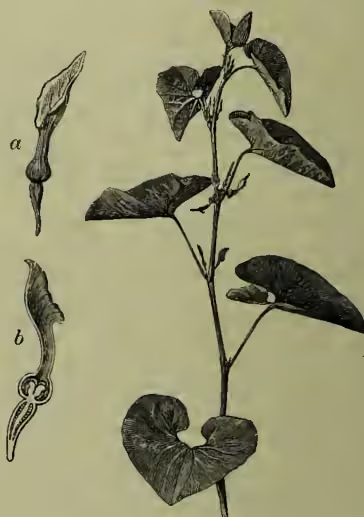
a, flower on larger scale; b, section of flower.
Aristolo'chia, a genus belonging to the dicotyledonous order Aristolochiaceae, which includes a large number of herbs and shrubs, frequently climbers, and which is specially abundant in tropical South America. Its affinities are obscure, owing to the peculiarly aberrant structure of its flowers: the tubular oblique perianth, dilated at its base, and the stamens adherent to the stigmas, are especially remarkable, and these characters are associated with a no less peculiar mode of fertilisation. The fertilising insects (usually small flies) attracted by the expanded and coloured lip of the perianth, as well as by the frequently powerful and fetid odour, descend the narrowed perianth tube into the dilated base. Thence they are prevented from returning by the downward-directed hairs, with which the perianth tube is lined; these, however, wither when the stamens are fully matured, and the flies escape, dusted with pollen, to enter another flower, and there become again imprisoned until after they have had abundant time to fertilise the stigmas, and acquire a new load of pollen in their efforts to escape. Several species of Aristolochia are found in the south of Europe; one only, the common Birthwort (A. clematitidis), occurs upon the Continent as far north as about lat. 50°, and is a doubtful native of England. The order is, however, also represented in Britain by Asarum europæum, or Asarabacca (q.v.). It has a long branching root, with an unpleasant taste and smell, which, with the roots of A. rotunda and A. longa, two herbaceous species, natives of the south of Europe, was formerly much used in medicine, being regarded as of great service in cases of difficult parturition, whence the name (Gr. aristos, 'best,' and locheia, 'childbirth'). These roots possess powerful stimulating properties, and those of the southern species are still used as emmenagogues. The root of A. indica is used in the same way by the Hindus.—A. serpentaria, Virginian Snakeroot, is a native of most parts of the United States, growing in woods. The root has long been a fancied remedy for the bite of the rattlesnake. It possesses stimulant and tonic properties.—Its reputation as a cure for serpent-bites is shared by other species, particularly A. anguicida and A. guaco (the Guaco of Colombia), natives of the warmer parts of America; and it is said that a number of species are used by Egyptian jugglers, in order to their handling serpents with impunity.—Several South American species seem also to possess medicinal properties analogous to those of the Virginian Snakeroot.—A. Sipho, a climbing shrub, of 15 to 20 feet in height, a native of the southern parts of the Alleghany Mountains, is frequently planted to form shady bowers, on account of its very large heart-shaped leaves (a foot in breadth), of a beautiful green. From the bowl-shaped base of its perianth, the plant has also received the name of Pipe-shrub, Pipe-vine, or Dutchman's Pipe.—Tropical species are distinguished for their beauty and the peculiar forms of their flowers, and are frequently cultivated in our hot-houses.