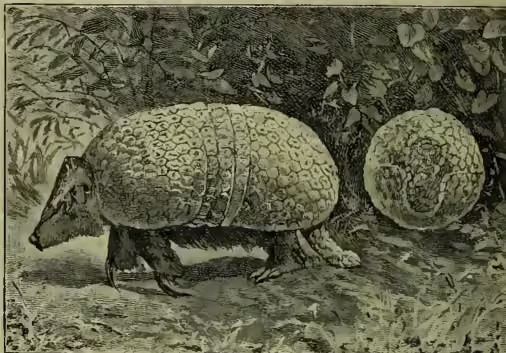
Armadillo (Dasyus), a genus of mammals in the order Edentata (q.v.). They are not, however, toothless, as the word Edentate would suggest, but provided with a variable number of simple molars, destitute of true roots, and distant from one another, so that those of upper and lower jaw interlock when the mouth is shut. Only in one case are there teeth which are not molars. The elongated snout bears at its tip the downward directed nostrils. The tongue is smooth, slender, and glutinous, but not long and extensible like that of the ant-eaters. The eyes are small and weak, probably in association with the burrowing habits of the animals, but the senses of smell and hearing are acute. The limbs are short and strong, and bear powerful claws, much used in burrowing. This they do very rapidly when in danger, while some, such as D. apar, protect themselves by rolling up into a ball and exposing only the armoured dorsal surface. This bony armour is indeed their most striking peculiarity, which distinguishes the genus from all other mammals except the allied Chlamydophorus. It consists of shields on head, neck, shoulders, and rump, and of movable cross bands of plates across the back. Even the tail may be thus armoured. In this way some of the armadillos have retained their foothold in the struggle with higher animals. Naturally timid and passive, they can, if forced, use their powerful claws in self-defence. They are nocturnal in habit, and feed on insects, worms, fruits, roots, and sometimes on carrion. They are distributed from Mexico and Texas southwards to Patagonia, and occur in immense numbers in the woods and pampas. The largest of the numerous species (D. gigas) is fully 3 feet long, exclusive of the tail, which measures a foot and a half more, while the smallest is not above 10 inches in length. Though all are eaten, the flesh of the more vegetarian species is particularly esteemed. Nearly allied is the small hairy Chlamydophorus, which has no shields, but a loose leathery armour formed of 24 cross bands of plates. In the pleistocene strata of South America, the armadillos are represented by giant fossil forms. See GLYPTODON.