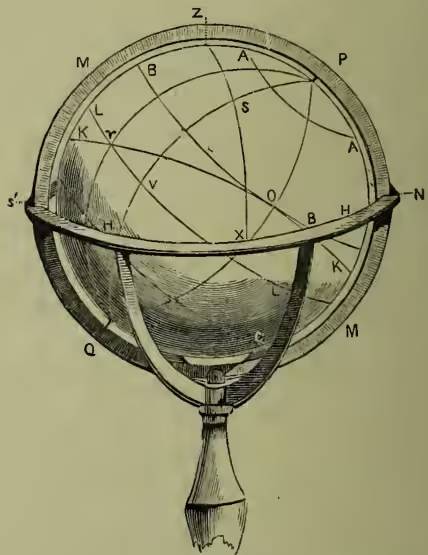
Armillary Sphere (Lat. armilla, 'a ring'), an instrument intended to give a just conception of the constitution of the heavens, and of the motions of the heavenly bodies, as seen by an observer on the earth. It consists of a number of rings fixed together so as to represent the principal circles of the celestial sphere, and these are movable round the polar axis within a meridian and horizon, as in the ordinary celestial globe. It was by means of such rings furnished with sights that Hipparchus, Ptolemy, and other ancient astronomers made many of their observations, and we find even Tycho Brahé making most of his planetary observations with the help of such an instrument. The armillary sphere is, however, now only used as an aid to instruction in astronomy, and in this respect is generally supplanted by the celestial globe. The object aimed at in the armillary sphere will be better understood by reference to the celestial globe represented in the diagram. Supposing the observer on the earth to be in the centre of the sphere, the earth on which he stands shuts out from his view the lower half of the heavens, or the part lying below the horizon, HH. The hemisphere above him may be regarded as divided into two equal portions, an eastern and a western, by the meridian, MM, which passes through the pole, P, and the zenith, Z, of which the eastern half is shown in the figure. The north pole is supposed to be elevated above the horizon, and its elevation is measured by the arc, NP, or the height above the north point; and the heavens appear to rotate round an axis, PQ, of which P is one extremity; the south pole, Q, the other extremity, being below the horizon. The meridian, MM, and the horizon, HH, are the only circles which maintain a fixed position with regard to the observer. Of the other leading celestial circles, the equator or equinoctial, LL, extending from the east to the west point of the horizon, the tropics of Cancer and Capricorn, respectively BB and CC, and the arctic circle, AA, although rotating with the stars, maintain the same position with regard to the horizon; while the ecliptic, KK, is constantly changing its inclination and position towards it. Circles which extend from pole to pole, cutting the equator at right angles, are called circles of declination. The circle which passes through the vernal equinox (see ARIES), is denominated the equinoctial colure; and that passing through the summer solstice, O (see SOLSTICE), the solstitial colure. The circles just named, together with the antarctic circle, are represented by corresponding rings in the armillary sphere. If S be a star, the following are the names given to the arcs which determine its position with regard to these circles; , right ascension; SV, declination; SP, north polar distance; SZ, zenith distance; XS, altitude; , azimuth, reckoned from the south pole westward.