Armour is a general term for the apparatus of personal defence, as distinguished from arms or weapons of offence. The commonest implement of defence in prehistoric and early historic times in Europe was the shield. The earliest known shields are of bronze, and circular, and were held in the left hand by a handle under the central boss. In addition to the shield, the early Greeks used greaves and helmets of bronze, and to these, in later times, a cuirass of bronze and back plates was added. The Romans added shoulder-guards to the cuirass, which was modelled to the bust, and furnished with a series of pendent plates, reaching almost to mid-thigh. It is not known when the tunic of interlinked rings, or coat of mail, first made its appearance in Europe. Flexible cuirasses were worn by the Roman Hastati, but there is no distinct evidence of their construction. Portions of was bound to have as many coats of fence (lorica), helmets, shields, and lances, as he had knights' fees in his domain; and the freemen and burgesses were to have habergeons or gambesons, and iron caps. The Scots had not generally adopted the use of defensive armour, for at the battle of the Standard, in 1138, the Earl of Strathearn is represented as saying: 'I wear no armour, yet they who do will not advance beyond me this day.' Towards the end of the 12th century, the round shield becomes rare, and the kite-shape gives way to the triangular or flatiron-shaped shield, and the conical helmet to the cylindrical and flat-topped form. In the first part of the 13th century, the hauberk and hose, or long chausses of mail, remained the usual body-armour of the knight; but in the second half of the century, the mail defences of the limbs began to be reinforced by portions of plate attached as shoulder-pieces, and elbow and knee pieces, to which were speedily added greaves or shin-pieces. The hauberk was made, in the beginning of the century, with a continuous coif for the head, and gloves not divided into fingers, but having an aperture in the centre of the palm. The coif of mail, which at the commencement of the 13th century was flat-topped, became round-topped in the second half of the century, and instead of it, the hood of mail, with a wide tippet which fell over the hauberk on the shoulders, was coming into use. Over the coif or hood, the great helm was worn in action, completely encasing the head, and perforated in front with small apertures for light and air. In the early part of the century, the cylindrical, flat-topped helm was the common form; in the middle of the century, the round-topped form prevailed; and by the end of the century, the top had assumed more of the form of a sugar-loaf. The armour was also extended from the man to the horse, which had a couverture of chain-mail fitting tightly to the head and neck, and falling loosely over the body.
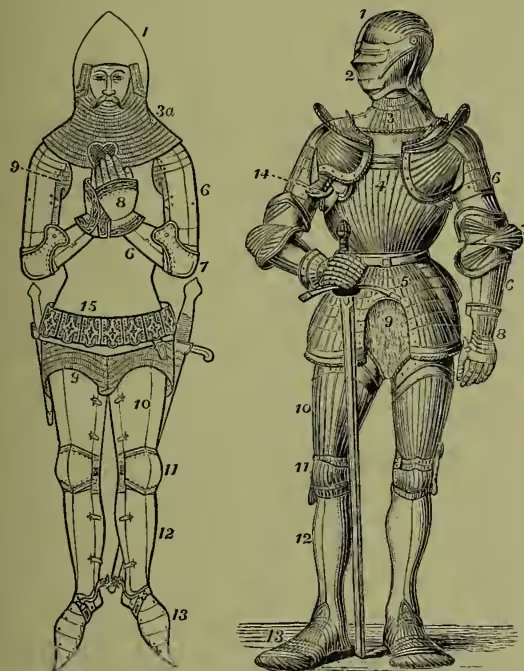
The 14th century was the period of the greatest development of body-armour, marking the transition from the coat of mail to the panoply of plate. The knightly equipment at this period necessitated the wearing of four or five different casings or defences over each other. Below the chain-mail, which was still worn, the quilted gambeson was needed to soften the pressure; over the mail was the corselet, with other reinforcements of plate, and over all, a second quilted garment, which might or might not be covered by the surcoat, usually worn uppermost for the purpose of displaying the knightly emblazonment. The hauberk now terminates at the neck, which is defended by a gorget of scale or plate. An ample corselet protects the breast, and the shoulders, elbows, and hands have each their special defences, either of articulated plates or single pieces. The reinforcements to the chausses or hose of mail which protected the legs in the previous century, gradually give way to complete defences of plate, the greaves fitting to the knee-pieces, and these to the thigh-pieces, till in the latter part of the century the legs were completely incased in tubular jambards, or jointed casings of plate, which opened upon hinges on the outside of the leg, and fastened on the inside. The feet were inclosed in sollersets, or shoe-like casings, of articulated plates, the long-pointed toe of the solleret marking the second half of the century. Under the pointed or dome-topped helm, the coif or hood of chain-mail is discarded for the bassinet, a high-peaked cap of steel, round the lower part of which is laced the upper edge of the camail or tippet of chain-mail falling down over the neck and shoulders. The helm, when placed over the bassinet, completely covers the head and face; it is perforated with clusters of small holes for breathing, 1, helmet; 2, visor; 3, gorget; 3a, camail; 4, breastplate; 5, skirt; 6, arm-pieces; 7, elbow-piece; 8, gauntlet; 9, hauberk; 10, thigh-piece; 11, knee-piece; 12, greaves; 13, sollerets; 14, lance-rest; 15, belt. chain-mail, formed of small riveted rings interlinked together, have been found in the mosses of Sleswick, associated with articles of decoration, exhibiting the influence of Roman art of about the 3d century. It seems unquestionable that chain-mail was in general use among the Northern nations long before the crusades. The enthusiasm engendered by the Holy Wars, however, gave a general impetus to the adoption of this species of personal defence, and under the feudal system, which prescribed for every man the arms and armour conformable to his condition, the period of the principal development of body-armour was reached. Disregarding the equipment of the common mass of combatants—which generally consisted of a suit of leather or other material quilted or stuffed, or padded with cotton or waste, or studded or masclad with small plates or scales of iron—the suits of armour worn by the knights and nobles were of costly workmanship, and splendidly adorned. In armour, as in dress, the changing fashions of the different periods are strongly marked. At the time of the Norman Conquest of England, or about the middle of the 11th century, the armour consisted of a hauberk or tunic of mail for the body, hose of mail for the legs, a conical helmet with nasal, and a circular or kite-shaped shield. This continued to be the style of equipment throughout the 12th century. By the assize of arms of Henry II. in 1181, every knight and for sight is furnished with a narrow cleft extending from temple to temple. Before the close of the century, the visored bassinet and camail were often used instead of the unwieldy helm. The shields were still triangular, but shorter than in the previous century. On the shield and surcoat were emblazoned the wearer's armorial bearings, and the military belt of this period, which confined the lower part of the surcoat, was often the most brilliant and costly part of the equipment, formed of elaborately worked plaques of precious metals, jewelled or enamelled, and furnished with pendants. The horses were almost as closely clad in plate as their riders; and in consequence of the weight they bore, a fall was often fatal to them both. In the 15th century, the development of plate-armour proceeded until, towards the middle of the century, body and limbs were completely enveloped in an articulated casing of iron plates.
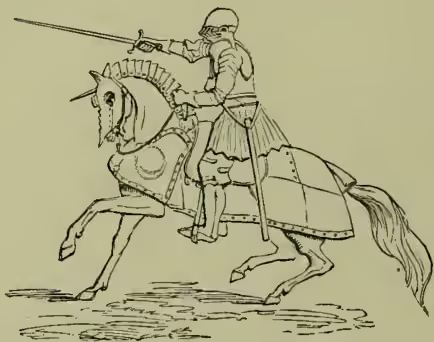
Articulations fitted to the upper parts of the arm-plates were carried over the shoulders, and the joints were protected by fan-shaped projections. The body, below the breast and back plates, was enveloped in a skirt of wide, hoop-like plates called tassets. To the lower part of these there were attached a series of more loosely hanging plates called tuilles. The leg defences are angular in front, the long-pointed toes of the solerets are shortened, and the gauntlets formed with articulating plates down to the points of the fingers. The bassinet and camail are being discarded in favour of the salade, a species of skull-cap, worn with a gorget and chin-piece separate from it. In this century, the introduction of gunpowder marks the period from which body-armour began to decline in importance, as being no longer proof against the new weapons of attack. The whole system of warfare was changed, tactics took the place of chivalry, and fortification of strong places against artillery superseded the system of iron-clad men. The full panoply of armour was still kept up for the joust and the tournament, but for actual service the tendency was henceforth in the direction of its disuse. In the 16th century, so prolific in changes, there was no longer the same uniformity of equipment. Instead of the long encircling skirt of hoop-like tassets, with tuilles attached, there is now a shortened skirt with a series of sliding and overlapping plates depending over each thigh, from the waist to the knee. The head defences are visored helmets or salades and morions. In the 17th century, officers and pikemen still retained the cumbrous body-suit of breast and back plates, with the short skirt of tassets and thigh-pieces; and in the 18th century, body-armour had been reduced to a mere embellishment of the military parade.
The most authentic sources of information as to the changing fashions of body-armour in the middle ages, are the miniatures of the illuminated manuscripts previous to the invention of printing, the Bayeux tapestry, and the monumental effigies and brasses of parochial and cathedral churches. The works of Grose, Meyrick, and Skelton may be consulted, or Hewitt's Ancient Armour and Weapons in Europe.