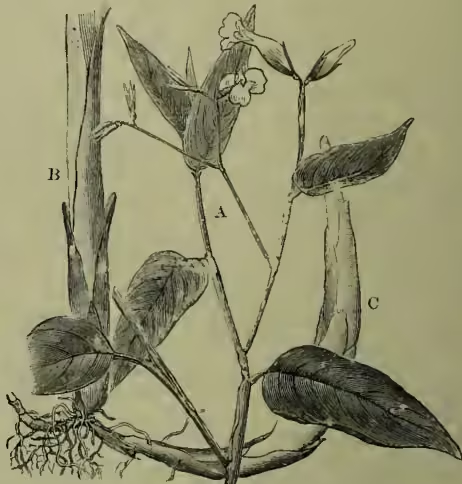
A, flowering branch; B, base of flower stem; C, branch of the rhizome. (From Bentley and Trimen's Medicinal Plants.)
Arrowroot is a variety of starch extracted from the roots of certain plants growing in tropical countries. It is a fine starchy farina, much valued as a delicacy, and as an easily digestible food for children and invalids. It is obtained from the root-stocks (rhizomes) of different species of Maranta, belonging to the natural order of Scitamineæ. The species chiefly yielding it is M. arundinacea, a native of tropical America, cultivated in the West India Islands, and growing about 2 feet high, with ovate-lanceolate somewhat hairy leaves, clusters of small flowers on two-flowered stalks, and globular fruit about the size of currants. The rhizomes are often more than a foot long, of the thickness of a finger, jointed, and almost white, covered with large papery scales. They are dug up when a year old, washed, carefully peeled, and reduced to a milky pulp. In Jamaica the roots are reduced by beating in deep wooden mortars; in Bermuda, by means of a wheel-rasp; but modern machinery has now been introduced. The pulp is then mixed with much water, cleared of fibres by means of a sieve of coarse cloth or hair, and the starch is allowed to settle to the bottom. The water dissolves, and so removes the greater part of the albumen and salts, the starch quickly settling down as an insoluble powder, which is then purified by successive washings. The arrowroot is finally dried in the sun or in drying-houses, from which dust and insects are excluded by means of gauze. The careful peeling of the roots is of great importance, as the skin contains a resinous matter which would impart a disagreeable flavour. Great precautions are taken against impurities; and the knives used in peeling the roots, and the shovels used in lifting the arrowroot, are made of German silver. The West Indian arrowroot most esteemed in the market is grown in Bermuda; the next, and almost equal to it, in Jamaica. The East Indian arrowroot is not in general so highly valued, perhaps because substitutes for the genuine arrowroot more frequently receive that name. The Maranta arundinacea is now, however, cultivated to some extent both in the East Indies and in Africa. M. indica is to be regarded as a mere variety, with perfectly smooth leaves. It is cultivated both in the East Indies and in Jamaica, and other species and varieties are sometimes cultivated. What is called Florida arrowroot is in part prepared from Zamia integrifolia; but the genuine Maranta arrowroot is also produced in Florida.
The amount of starch present in the rhizomes varies, according to age, from 8 to 26 per cent.
Arrowroot is exported in tin cases, barrels, or boxes, carefully closed up. It is a light, opaque, white powder, which, when rubbed between the fingers, produces a slight crackling noise, like that heard when newly fallen snow is being made into a snowball. Through the microscope the particles are seen to be convex, more or less elliptical, sometimes obscurely triangular, and not very different in size. The dry starch is quite inodorous, but when dissolved in boiling water, it has a slight peculiar smell, and swells up into a very perfect jelly. Potato-starch, with which it is often adulterated, may be distinguished by the greater size of its particles, their coarser and more distinct rings, and their more glistening appearance. Refined sago-flour is used for adulteration, many of the particles of which have a truncated extremity, and their surface is irregular or tuberculated. Arrowroot is also sometimes adulterated with rice-starch, and with the common starch of wheat-flour.
Tapioca (see MANIOC) was formerly sometimes called Brazilian arrowroot; and the starch prepared from many other plants has often also usurped the name. Thus 'Chinese arrowroot' is said to be from the tubers of Nelumbium speciosum. East Indian arrowroot is often prepared from different species of Curcuma (see TURMERIC), while Dion edule, Zamia, and other ceyads are used in Mexico, Tacca oceanica in the Sandwich Islands, and so on; even the starch of maize sometimes appearing as Oswego arrowroot, that of Arum as Portland arrowroot, and that of potato as 'English arrowroot!' Although materially differing in rate of digestibility, arrowroot proper having in this respect the advantage, all these varieties of starchy food have much the same nutritive value, and all alike require the addition of milk to form an adequate food. It should further be borne in mind that all starches alike are indigestible to infants, whose salivary ferment is undeveloped.
The name arrowroot had its origin from the use of the fresh roots as an application to wounds to counteract the effects of poisoned arrows; and the expressed juice has been accordingly recommended as an antidote to poisons, and a cure for the stings and bites of venomous insects and reptiles.