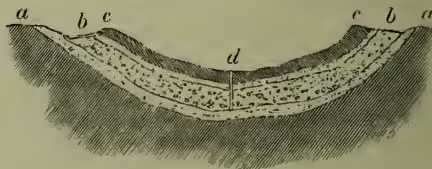
Artesian Wells are perpendicular borings into the ground, through which water rises from various depths, according to circumstances, above the surface of the soil. The possibility of obtaining water in this way in a particular district depends on its geological structure. All rocks contain more or less water. Arenaceous rocks receive water mechanically, and according to their compactness and purity, part with a larger or smaller proportion of it. A cubic yard of pure sea-sand can contain about one-third of its bulk of water. It would part with nearly the whole of this into a well sunk in it, and regularly pumped from. Chalk and other rocks, composed of fine particles, closely compacted together, contain as large a proportion of water; but from the power of capillary attraction, little or none of this water would be drained into a well sunk in such rock. From the existence, however, of numerous crevices in chalk through which the water freely flows, and from the general presence of a larger quantity of water than the porous rock is able to retain, wells sunk in chalk often yield water. There is yet a third class of rocks, which are perfectly impervious to water: such are clays, which are absolutely retentive, neither allowing water to be obtained from them nor to pass through them. When such rocks occur in Basins (q.v.) in alternating layers, and in such order that pervious beds are inserted between impervious ones, it is evident that if a perforation is made through the retentive barrier-bed in the lower portion of the basin, the water contained in the water-logged strata will rise through the bore to a height depending upon the pressure of water which has accumulated in the confined sloping space between the two impervious beds. The explanation will be more evident by a reference to the accompanying figure, which may be considered as a diagrammatic section of the London basin. There are here a number of porous beds, b, c, composing the cretaceous measures, resting on the impervious gault, aa, and these, again, are covered by the equally impervious series of the London clay, cc, which form the strata on the surface, and extend to a considerable depth. The edges of the chalk-beds are largely exposed in the higher grounds around London; the water falling on the whole area of these exposed edges, sinks into the more or less porous cretaceous beds, and would, in course of time, by continued accessions, fill up the basin, were it not prevented by the clay above. By driving a bore, d, through this superior bed, the inferior water-logged strata are reached, and the subterranean water rises to the surface, and flows continuously, by means of hydrostatic pressure.
Many such wells exist in London and its vicinity; those which, since 1844, have supplied the ornamental fountains in Trafalgar Square descend into the upper chalk to a depth of 393 feet. The most famous artesian well perhaps is that of Grenelle, near Paris, which was bored in 1833-41, and whose water is brought from the gault at a depth of 1798 feet. It yields 516½ gallons of water in a minute, propelled 32 feet above the surface; temperature, 81°·7 F. An artesian well bored at Pesth in 1868-79, yields, at a depth of 3182 feet, water of a temperature of 165° F. In the United States, numerous artesian wells have been sunk, some of great depth, among which are two in St Louis, Missouri, 2197 and 3843½ feet deep respectively; several in Chicago of from 700 to 1200 feet in depth; one in Louisville, Kentucky, 2086 feet deep; one in Columbus, Ohio, 2775½ feet in depth, with many others from 500 to 2000 feet deep.
The Chinese and Egyptians were early acquainted with artesian wells. The oldest known in Europe is at Lillers, in Artois (hence the name Artesian), and was sunk in 1126. They have been in use for centuries in Austria, especially in the neighbourhood of Vienna, where formerly the boring for them was conducted in a rude and empirical manner. As soon as geology took the position of a science, and the theory of artesian wells was propounded, the engineer was able, after the geological survey of a district, to discover whether a supply of water could there be obtained in this way. Already, districts formerly dry and arid have received a plentiful supply of water by means of such wells, and many more applications have yet to be made. Artesian borings have been executed in the Sahara from remote antiquity, and new ones have been opened by the French in the Algerian Sahara with remarkable success, and great benefit to the country and the nomad Arabs, who settle down round the wells. In West Queensland 500 artesian wells, some 4000 feet deep, but averaging 1170 feet, produce nearly 195,000,000 gallons of water daily, and have transformed much country from aridity to fertility; occasionally the water is brackish. East of the coast range, about a score average 13,200 feet. At Schladebach in Prussia there is one nearly a mile in depth.
Artesian wells have supplied a portion of the data upon which the internal temperature of the earth has been calculated. They have their origin below that zone which is affected by the changing superficial temperature of the seasons, and consequently the water is of a constant temperature. Thus the Grenelle artesian well has a temperature of 81°·7 F., while the mean temperature of the air in the cellar of the Paris Observatory is only 53°. MM. Arago and Walferdin observed the temperature as the work proceeded, and found that there was a gradual and regular increase downwards. Walferdin also made a series of very accurate and careful observations on the temperature of two borings at Creuzot, within a mile of each other, commencing at a height of 1030 feet above the sea, and going down to a depth, the one of 2678 feet, the other about 1900 feet. The results, after every possible precaution had been taken to insure correctness, gave a rise of 1° F. for every 55 feet down to a depth of 1800 feet, beyond which the rise was more rapid, being 1° for every 44 feet of descent.