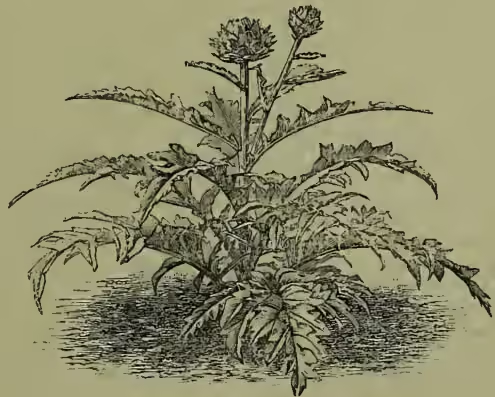
Artichoke (Cynara Scolymus), a thistle-like perennial plant belonging to the tubulifloral group of composites, now growing wild in the south of Europe, but probably a native of Asia. The radical leaves are 3 to 4 feet long, somewhat spiny, pinnatifid, or undivided. The stem is 2 or 3 feet high, branched, with large heads of violet-coloured (sometimes white) thistle-like flowers at the summits of the branches. The plant has been long cultivated for the sake of the delicate succulent receptacle or broadened axis of the flower-head, taken before the flower expands, which is boiled and eaten with melted butter, or sometimes eaten raw with salt and pepper. The part used is the same which is called the cheese in thistles by children, and is sometimes eaten by them. The tender central leaf-stalk is also occasionally used in the same way as that of the Cardoon. Several varieties are in cultivation, differing in the more or less spiny leaves, and the more or less globose form of the head. Artichokes are generally propagated by rooted slips or suckers in spring. These are planted in rows about 4 feet asunder, and 2 feet apart in the row. The artichoke bed continues productive for several years. Seaweed is an excellent manure.—The Cardoon (q.v.) belongs to the same genus.—The Jerusalem Artichoke (q.v.) is a totally different plant, being a kind of sunflower (Helianthus tuberosus).