Artificial Limbs are mechanical contrivances adapted to reproduce the form, and as far as may be, the function of a lost or absent member. They have, in one form or other, been in use from very early times. Herodotus mentions the case of a prisoner who amputated his own foot to escape from his shackles, and, escaping to his friends, was provided with a wooden substitute. The brave M. Sergius, great-grandfather of Catiline, was consul in the year 167 B.C. He lost his right hand in his second campaign; and received twenty-three wounds, so that neither his remaining hand nor his feet were fully serviceable. Notwithstanding this, he fought in four battles with his left hand only; afterwards he made himself an iron hand, and fighting with it fastened on, was instrumental in raising the siege of Cremona, in protecting Placentia, and in storming twelve of the enemy’s camps in Gaul, during the second Punic war (Pliny, Hist. Nat. 28, 104–106). In 1885 a remarkable specimen was discovered in a tomb at Capua along with other relics dating from 300 B.C.; it is thus described in the catalogue of the London Royal College of Surgeons, where the specimen is preserved: ‘Roman Artificial Leg.—The artificial limb accurately represents the form of the leg. It is made with pieces of thin bronze fastened by bronze nails to a wooden core. Two iron bars, having holes at their free ends, are attached to the upper extremity of the bronze. A quadrilateral piece of iron, found near the position of the foot, is thought to have given strength to it. There was no trace of the foot, and the wooden core had nearly all crumbled away. The skeleton had its waist surrounded by a belt of sheet bronze, edged with small rivets, probably used to fasten a leather lining.’ The upper third of the leg was hollow, while the lower two-thirds were filled with wood.
The celebrated artificial hand of the German knight, Götz von Berlichingen—‘Götz of the Iron Hand’—was invented about 1504 by a mechanic of Nuremberg. It weighed three pounds, and was so constructed as to grasp a sword or lance. In the twelfth chapter of Ambrose Paré’s Œuvres de Chirurgie, as translated by Thomas Johnson in 1605, it is described ‘by what means arms, legs, and hands may be made by art, and placed instead of the natural arms, legs, and hands that are cut off or lost.’ No improvements worthy of record were made from the time of Ambrose Paré till the beginning of the present century, when Baillif of Berlin constructed a hand which did not exceed a pound in weight, and in which the fingers, without the aid of the natural hand, not only exercised the movements of flexion and extension, but could be closed upon and retain light objects, such as a hat, and even a pen. Recent years have seen great advances in the adaptation of these mechanical contrivances to varied requirements. The first desideratum in an artificial limb is lightness. This applies equally to both upper and lower extremities. In other respects, however, important differences exist between what is desirable in an artificial arm and what in an artificial leg. In the former, mobility, to the extreme limit compatible with control over its movements, is wished for; in the latter, stability is chiefly thought of. The artificial arm is destined to reproduce as far as possible the prehensile powers of the lost upper extremity; the artificial leg, the weight-supporting function of the natural lower limb. In both, the mechanical appliance must fit accurately and grasp firmly the stump of the natural limb; and this without exerting injurious pressure or causing discomfort at any point.
Arms.—The utility of an artificial arm depends much on the nature of the stump. A stump above the elbow is most suitable when it tapers gradually to its lower end, and terminates in a rounded surface. When an arm is removed at the shoulder-joint, and there is no stump, an artificial arm can still be fixed in its proper place by means of a corset. In amputation below the elbow-joint, the best stump is one formed by amputation at the wrist. The simplest form of artificial arm after amputation above the elbow, consists of a leathern sheath accurately fitted to the upper part of the stump. The lower end of the sheath is furnished with a wooden block and metal screw-plate, to which can be attached a fork for holding meat, a knife for cutting food, or a hook for carrying a weight. The arm should be so carried as to represent the position of the natural arm when at rest. It is retained in its position by shoulder and breast straps, and forms a light, useful, and inexpensive substitute for the lost member. More complicated, and therefore more expensive pieces of apparatus are made, in which motion is given to the fingers, a lateral action of the thumb is obtained, the wrist-movements are partially imitated, and a degree of natural softness given to the hand by a covering of gutta-percha and india-rubber. Nothing has tended so much to the very highest development of artificial arms and hands, as an accident which happened more than a quarter of a century ago to the celebrated French tenor, M. Roger, who lost his right arm above the elbow. It was necessary, for his future appearance on the stage, that he should have an artificial limb, which would serve the purposes of histrionic action, and permit him to grasp a sword and draw it from its scabbard. Such a contrivance was invented in 1845 by Petersen, a Prussian mechanician, and the French Academy of Sciences commissioned MM. Gambey, Rayer, Velpeau, and Magendie to report upon it. The apparatus, which weighed less than 18 ounces, was tested upon a soldier who had lost both arms. By its aid he was enabled to pick up a pen, take hold of a leaf of paper, &c. Petersen's conceptions were improved by Messrs Charriere, the celebrated
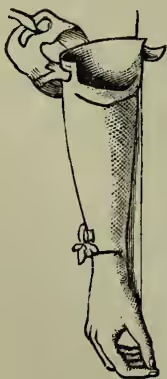
The Beaufort arm (fig. 1) possesses a similar 'instinctive' power of movement. It consists of a wooden hand attached to a leathern socket that firmly fits the stump. The fingers are half-closed parallel to one another, the first two finger-tips opposing that of the movable thumb. The thumb is pivoted on a pin concealed in the ball of the thumb; it is firmly pressed against the finger-tips by a strong india-rubber band similarly concealed. A piece of whip-cord is attached to the back of the thumb, whence it runs upwards to the shoulder of the wearer, and across his back to the opposite shoulder, around which it is fastened by a tape loop. By drawing upon and relaxing the whip-cord, the grasp of the thumb is alternately opened and closed; and these movements can be attained by slight movements of the shoulders, or by advancing and retracting the artificial arm. This arm was adopted by the French government for distribution to soldiers maimed in the Franco-German war of 1870-71. It is a remarkably efficient appliance, and has the advantage of cheapness, so that it is within the reach of all classes.
Legs.—The object in view here is to support weight, and to supply movement useful in progression. Weight can be borne in three ways in an artificial leg: (1) On the end of the stump; (2) by the contact-friction between the surface of the limb and a tightly fitting sheath; and (3) on the tuberosity of the ischium or 'sitting bone.'
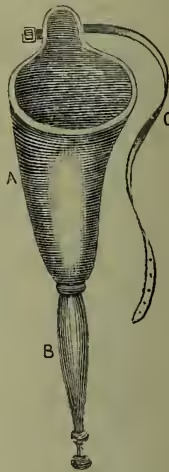
The simplest artificial leg is the 'bucket' leg (fig. 2), consisting of a hollow wooden or leathern sheath, A, fitting accurately to the contour of the stump, and having a 'peg,' B, firmly attached to its lower end. The weight is here chiefly borne by the 'sitting bone,' which reposes on the smooth brim of the 'bucket.' The end of the stump should not quite reach the floor of the 'bucket;' hence it takes no part in supporting the weight of the body, which might give rise to pain in the stump. This appliance is suited only for amputation through the thigh. Its great defects are the absence of bending at the knee, and the absence of a foot, which makes it useless on soft ground.
Of the more complicated forms of artificial leg three are especially popular. The first of these is of English origin, and owing to its having been adopted by the Marquis of Anglesey, is known as the Anglesey leg; it is fully described in Gray's work on Artificial Limbs. The second is that invented by an American named Palmer, and called the Palmer leg. From its lightness and the greater ease of walking with it, it soon superseded the Anglesey leg in America. In the third, also invented in America, and known as Dr Bly's leg, the principal faults of the two other legs have been completely overcome. The advantages of this leg are thus summed up by Mr Bigg: (1) Adaptation to all amputations either above or below the knee. (2) Rotation and lateral action of the ankle-joint. (3) Power on the part of the patient to walk with ease on any surface, however irregular, as, owing to the motion of the ankle-joint, the sole of the foot readily accommodates itself to the unevenness of the ground. (4) The ankle-joint is rendered perfectly indestructible by ordinary wear, owing to its centre being composed of a glass ball resting in a cup of vulcanite. (5) The action of the ankle-joint is created by five tendons, arranged in accordance with the position assigned to them in a natural leg. These tendons are capable of being rendered tight or loose in a few seconds, so that the wearer of the leg has the power of adjusting with precision the exact degree of tension from which he finds the greatest comfort in walking. (6) There is a self-acting spring in the knee-joint, urging the leg forward in walking, and imparting automatic motion. (7) The whole is covered by a flesh-coloured enamel, which can be washed with soap and water. (8) At the knee-joint there is a mechanical arrangement representing the crucial ligaments, and affording natural action to that articulation by which all shock to the stump in walking is avoided. Hermann's artificial limb is still more highly approved by many, as affording more support when the knee is bent. See Max Schede's work on Amputation, and the System of Surgery by Holmes and Hulke (3d ed. 1883).
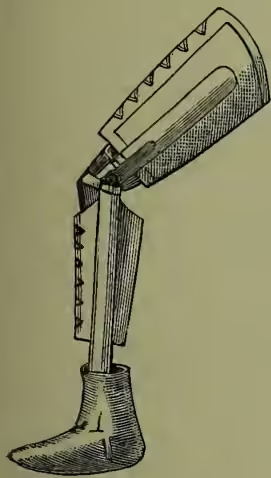
The Beaufort leg (fig. 3), invented by the Count de Beaufort in 1851, and improved subsequently, has three great recommendations: it lengthens the stride that can be safely taken, it reproduces the natural gait, and it is remarkably cheap. Baron Larrey, the celebrated French surgeon, reported on this invention to the Academy of Medicine, that 'it consists of a piece of ash-wood, which, like the peg, is attached to the ordinary wooden leg. It replaces the metal disc of the peg, and is shaped somewhat like a foot, but shorter in length. The plantar surface is covered with a leathern sole, garnished with cork at the heel. It is curved in form, the curve being such as to give the limb continuous lines of bearing on the ground while the body moves forward, save that the curve is not so perfectly uniform as to involve any danger of slipping.' He shows how the curved sole is instrumental in increasing stability, in lengthening the pace, and in giving it a natural character. In 1865 this new form of foot was adapted to a new leg-case, with lateral supports of ash-wood, and a joint corresponding to the knee, applicable to cases of amputation of all sorts. These limbs are now made in London by the Provident Surgical Appliance Society. For artificial eyes, noses, palates, teeth, see EYE, RHINOPLASTIC OPERATIONS, PALATE, DENTISTRY, TEETH.