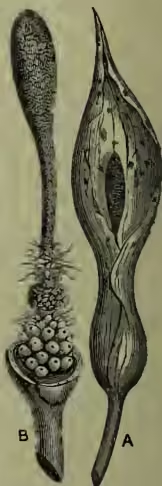
Arum, a genus of spadiceifloral monocotyledons, belonging to the natural order Araceæ or Aroideæ. This order is chiefly tropical, and comprises herbaceous plants, some of which are stemless; shrubby plants, some of which are arborescent; and plants which climb by aerial roots, clinging to the trees of tropical forests. The leaves are sheathing at the base, convolute in bud, usually with branching veins. The small degenerate flowers are crowded upon the elongated axis or spadix, which is generally inclosed by a large bract or Spathe (q.v.), frequently coloured or white: the male flowers are aggregated at the upper part of the spadix, and the female flowers towards its base. In some species, a stench like that of carrion is produced during flowering, as well as a remarkable degree of heat. Plants are of course slightly warmer than the air around them, the heat being produced by the breaking up and oxidation of their protoplasm, and by the true respiration, in short, which goes on in all living tissues (see ANIMAL HEAT); but flowers, in general, are only or warmer than the air, whereas the flowers of some of the Arums and nearly allied plants are sensibly warm to the touch, and that of A. cordifolium has been found to have a heat of F., when that of the air was only F.—The only British species is A. maculatum, Cuckoo-pint, Lords and Ladies, or Wake-Robin, abundant in England and most parts of Europe, growing chiefly in moist shady woods and under hedges. It has a tuberous perennial root; its leaves are all radical, on long stalks, strongly arrow-shaped, often spotted; the spathe greenish yellow, inclosing a rather short violet or brownish-red spadix. It produces scarlet berries, 1-2 seeded, about the size of peas, clustered upon the spadix. The root has a burning acrid taste, which, however, it loses in drying or boiling.
In a fresh state, it is a drastic purgative, too violent for medicinal use; and, indeed, it, as well as the leaves, is an active poison; yet a nourishing farina is prepared from it, after the acrid juice has been removed. This farina is a pure starch, and is known in England by the name of Portland Sago or Portland Arrowroot. It was formerly prepared to a considerable extent in the Isle of Portland, where also the tubers (corms) themselves were eaten by the country-people. They lose great part of their acridity in drying, and were formerly used in medicine as a stimulant in impaired digestion, a diuretic in dropsies, and an expectorant in chest complaints. The plant is cultivated in India for food.—A. indicum is also cultivated in Bengal for its esculent stems and small pendulous tubers.—Acridity in the juice, and the presence of an abundant and nutritive store of starch, from which the acrid juice is easily separated, are characteristics of many plants of this order, particularly species of Caladium and Colocasia, much used for food in warm countries, under the names Cocco (q.v.), Eddoes, &c.—Amorphophallus campanulatus (A. campanulatum), called Ol by the Bengalese, is cultivated in some parts of India for its corms, which form a very important article of food; yet in a fresh state it is so acrid that it is employed as an external stimulant. The peculiar acridity of the order is most remarkably displayed in Dieffenbachia, the Dumb Cane (q.v.).—Two large species of Arisæna, another genus very closely allied to Arum, were found by Dr Hooker to afford food to the inhabitants of the Sikkim Himalaya at an elevation of upwards of 10,000 feet. Their tuberous roots are bruised by means of wooden pestles, and thrown into small pits with water, until the commencement of acetous fermentation, when the acridity is mostly dissipated; but the process is so imperfect that cases of injury from the poisonous juice are frequent. The tubers of Arisæna atrorubens, a native of the United States, and there known as Dragon-root and Indian Turnip, yield a pure white starch like that of A. maculatum.—The Dragon-plant, A. Dracunculus, a native of the south of Europe, is sometimes seen in gardens in Britain, despite its carrion-like smell.—The so-called 'Lily of the Nile,' so commonly used as a decorative plant in this country on account of its white spathes and large leaves, is Richardia (Calla) athiopica.