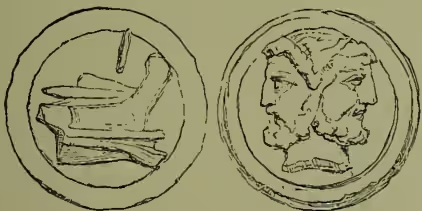
As was the designation both of a Roman weight (called also libra) corresponding very nearly to an English pound, and also of a coin made of the mixed metal aes, or bronze. The weight was divided into 12 parts; the uncia = , the quadrans = , the sextans = as, &c. The as (coin) originally no doubt weighed a (Roman) pound, of the value of about 8d., and was uncoined until Servius Tullius stamped it with the figures of animals, hence the Latin pecunia, 'money,' from pecus, 'cattle.' Pliny tells us that in the first Punic war, on account of the scarcity of money, the as was reduced to two ounces, a sixth of its ancient weight, and that thus the republic paid off its debts, gaining five parts in six; that afterwards, in the second Punic war, during the dictatorship of Q. Fabius Maximus, it was again reduced one-half, to one ounce, and the denarius was decreed equal to sixteen ases, the republic thus gaining one-half; and that soon after, by the Papirian law (191 B.C.), ases of half an ounce were made. When the denarius was equal to ten ases, the value of the as was a little more than three-fourths; when sixteen ases went to the denarius, its value was about a halfpenny. It was by the silver coin, the Sestertius (q.v.), that money was reckoned at Rome. It was originally equivalent to 2 ases, or one-fourth of a denarius.