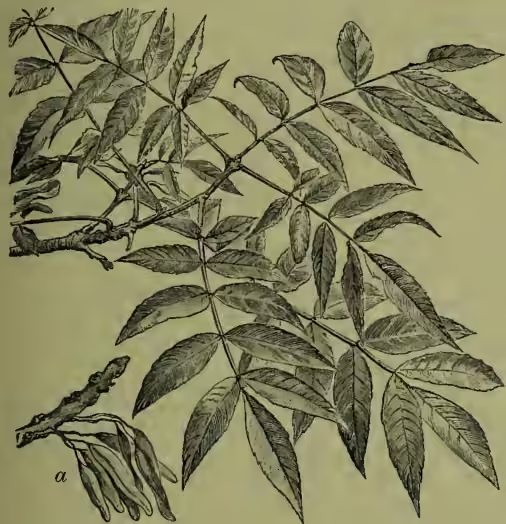
Ash (Fraxinus), a genus of trees belonging to the natural order Oleaceæ, and distinguished by very imperfect flowers, in which the calyx is obsolete, and the corolla either wanting or 3-4-partite; the fruit is a samara, a seed-vessel winged at the edges and extremity. The leaves are deciduous, and are pinnate with a terminal leaflet. There are about fifty species, mostly natives of Europe and of North America.—The Common Ash (F. excelsior) grows wild in the middle and south of Europe and north of Asia, and is an undoubted native of Britain. It is a beautiful and umbrageous tree, highly ornamental in parks, but extremely injurious to the grass or crops immediately around it. It rises to the height of 100-150 feet, generally with a smooth stem. The wood is white, tough, and hard, much valued by wheel-wrights, cart-wrights, coach-makers, joiners, and turners. It ranks next in value to that of the oak for strength and durability, and is adapted to a much wider range of uses. It is also excellent for fuel. Sometimes it becomes irregular in the disposition of its fibres, and finely veined, and is then prized by cabinetmakers. The wood of the young trees is almost as valuable as that of the old. Indeed, the value of the timber is greatest in trees of which the growth has been rapid, as it exhibits the characteristic toughness in the highest degree. The ash prefers a loamy soil, but grows in almost any, and succeeds in situations too elevated or too exposed for most other trees. Cultivation has produced and perpetuated a number of varieties, of which the most remarkable are the Weeping Ash, with boughs bent almost straight down to the ground; the Curl-leaved Ash, with dark-green wrinkled or curled leaves; and the Entire-leaved Ash, a very curious variety, with many or all of the leaves simple (not pinnated), which has been erroneously regarded by some botanists as a distinct species, and named F. simplicifolia, F. heterophylla, &c.—The Small-leaved Ash (F. parvifolia) and the Lentisk Ash (F. lentiscifolia) are both natives of the shores of the Mediterranean, and are very graceful and ornamental trees.—The American Ash, or White Ash (F. americana), is readily distinguished from the Common Ash by its lighter bark and paler green leaves. It is abundant in New Brunswick and Canada, but becomes rare to the south of New Jersey. The trunk often rises more than 40 feet undivided. The wood is used for the same purposes as that of the Common Ash.—The Red Ash, or Black Ash (F. pubescens), is very similar, but of smaller size, and has a deep brown bark. It is most abundant in Pennsylvania, Maryland, and Virginia, especially in swampy ground.—The Black Ash, or Water Ash of the New England States, New Brunswick, &c. (F. sambucifolia), is a large tree with buds of a deep blue colour.—The Blue Ash of Ohio, Kentucky, Tennessee, &c. (F. quadrangulata), is also a large tree. The branches are quadrangular, the young shoots having on the angles four membranes which extend their whole length.—The Green Ash (F. juglandifolia), readily recognised by the brilliant green of its young shoots, is chiefly found in the middle States; and the Carolina Ash (F. caroliniana), remarkable for the great size of its leaflets, chiefly in the southern States. Besides these, North America produces a considerable number of other species or varieties. The wood of all of them is used for somewhat similar purposes to that of the Common Ash, but none of them have proved of any value as forest trees in this country, in so far as experience gained from limited experiments in that direction shows.
Among other trees bearing the name ash in one form or other is the Manna Ash, or Flowering Ash (Ornus europæa), closely related to the true ash, and formerly named F. ornus, but now, on account of some structural distinctions in its flowers, generally regarded as a separate genus. The tree strongly resembles the Common Ash in foliage, but is smaller, and cannot be considered a timber tree of any importance. It is a native of the south of Europe, and is very abundant in Sicily, whence the finest manna is obtained. An allied species (O. rotundifolia), a native of Greece and the Ionian Islands, also produces manna in quantity, but not equal in quality to that of the other species. Manna is the concrete juice of these two trees, and is obtained by means of transverse incisions in the bark, but it often also exudes spontaneously during the heat of summer.—The Mountain Ash, or Rowan Tree (q.v.), so called on account of the resemblance of its foliage to that of the Common Ash, belongs to the natural order Rosaceæ.
The ash has a peculiar importance in Scandinavian mythology. The first man and woman formed were Ask and Embla (Ash and Elm). The court of the gods is represented in the Edda as held under an ash, called Yggdrasil (q.v.). The ash was in many countries, and from ancient times, believed to be a powerful defence against witches, fairies, poisonous animals, and some diseases. In the Highlands of Scotland, ash sap was administered to infants as their first food; elsewhere, herd-boys preferred an ash rod as a herding stick; in Cornwall a single blow from an ash wand was death to an adder. Gilbert White tells that in Selborne ruptured children used to be passed naked between the sides of a cleft ash tree in order to be healed. It was held dangerous to break a bough from the ash. The Mountain Ash (see ROWAN) had also magical powers.
The Poison Ash (Rhus venenata) is a gum or varnish bearing tree or shrub of North America, and belongs to the natural order Anacardiaceæ.—The Bitter Ash (Simaruba officinalis) yields the powerful tonic drug known as Simaruba Bark. The tree is a native of the West Indies.—The Cape Ash (Ekebergia capensis) is a valuable timber tree of the Cape of Good Hope; among the timber trees of the Cape it occupies a similar position to the Common Ash in this country, but is in no way related to the latter; it belongs to the natural order Meliaceæ.—Prickly Ash (Xanthoxylum fraxineum) is a native of the United States, where it is also called Toothache Tree. The bark, the leaves, and seed-vessels abound in volatile, aromatic, oily and resinous constituents, and a peculiar principle named Xanthoxylin, which are used in the United States in various forms for the cure of toothache and chronic rheumatism.