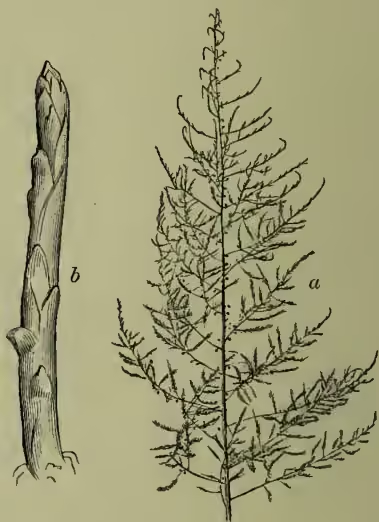
Asparagus, a genus of Liliaceæ; it contains sixty to seventy species, usually herbaceous, but sometimes shrubby or climbing; the stem is unarmed in some, in others thorny; the young shoots covered with leaf-scales, afterwards very much branched, with numerous fasciculate, generally bristle-like 'leaves,' which are really abortive branches or flower-stalks, the true leaves being reduced to minute scales. The most widely diffused species is the Common Asparagus (A. officinalis), a native of Europe, which grows on the banks of rivers and on the sea-shore, in meadows and bushy places, especially in sandy soils, occurring wild in a few places in Britain, and which is also in general cultivation as a garden vegetable; its young shoots, when they first sprout from the earth, form a much esteemed article of food, which, however, is only in a slight degree nutritious. These sprouts contain a peculiar crystalline substance, called Asparagine, and have a specific action on the urinary organs, so that their long-continued use in very large quantities is apt even to produce bloody urine. They are no longer retained in the pharmacopœia, but both the shoots and the roots of asparagus are still occasionally used as a diuretic in dropsies, and as a lithic to dissolve urinary calculi. For these purposes, the root is preferred, and is administered in the form of an infusion or decoction.—The thick and tender kinds of asparagus are most esteemed for the table. By cultivation it is much increased in size, and considerably altered in general appearance. In its wild state it is seldom more than a foot high, and not much thicker than a goose-quill; whereas it can be obtained in gardens more than half an inch in diameter, while its stems may rise to the height of four or five feet. Asparagus was a favourite vegetable of the ancient Romans. It is raised from seed, and grows best in a rich, fresh, sandy soil. The seed is generally sown in spring, either in the prepared bed, or in drills, from which the shoots may be transplanted when one year old. In England, it is generally planted in rows, at distances varying from 1 foot to 2½ feet, in beds that have been previously prepared by deep trenching (usually 2½ to 3 feet) and rich manuring. The shoots should not be cut till the second year after planting, and then very sparingly at first. Litter or vegetable mould is spread over the bed in autumn. It is allowed to occupy the same ground for many years; well-made beds continuing in a good bearing condition for twenty years or more. Asparagus is grown more extensively in France, where large quantities are raised among the vines. The French method differs chiefly in the substitution of more surface manuring for the English practice of preparing and enriching the bottoms of the beds.—The seeds have been used as a substitute for coffee, and a kind of spirit has been made from the fermented berries. The young shoots of several other species are also eaten, as those of A. tenuifolius, A. acutifolius, and A. albus, natives of the south of Europe; the last of which is used in Spain and Portugal as a salad, in soups, and as a boiled vegetable. On the other hand, the sprouts of the Bitter Asparagus (A. scaber), which is very similar to the Common Asparagus, are uneatable on account of their great bitterness.