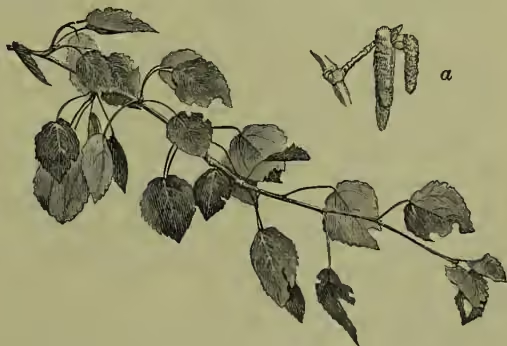
Aspen, or TREMULOUS POPLAR (Populus tremula; see POPLAR), a tree which grows plentifully in Europe and in Siberia. It is a native of Britain, and is frequently found in Scotland, where it is met with even at an elevation of 1500 feet above the sea. It has received the specific name tremula, from the readiness with which its leaves are thrown into a tremulous motion by the slightest breath of wind—a property for which, indeed, the aspen-leaf has become proverbial. The leaves are nearly orbicular, but broadly toothed, so as almost to exhibit angles. The footstalks are long, slender, and compressed, which favours the readiness of motion. It grows quickly, with a straight stem, reaching to a height of from 60 to 80, or even 100 feet. The wood is soft, porous, light, white, and smooth; it does not make good fuel, but is very fit for the turning-lathe, and especially for being made into troughs, trays, and pails; whilst in France it is used for sabots. If the stem be peeled and allowed to dry before it be cut down, the wood becomes harder, and is then capable of being used as timber for the interior of houses; and on this account the tree is of great importance in many districts, and the more so as it succeeds in any soil, although it prefers one which is moist and gravelly. The bark contains a great quantity of a bitter alkaloid, Salicin. The charcoal made from this tree can be used in the manufacture of gunpowder. The peculiar quivering of the leaves of the aspen has given origin to a wealth of legendary and literary associations with the tree. The old legend that it supplied the wood of the Cross, and has never since ceased to tremble, is even yet quoted as the cause of its ceaseless quivering. It appears to have been highly valued as a timber tree in the time of Henry V., particularly for the making of arrows. An act of parliament was passed in that reign preventing the consumption of the aspe for any other purpose, under a penalty of a hundred shillings. This act was only repealed in the reign of James I.—Populus tremuloides, a very similar species, a native of North America, is called the American aspen. It is regarded by some as a mere variety. Very similar, also, is another North American species, P. grandidentata.